

“I try to take away as much editing from the start. Detailed briefs really help with that."
My guest on the podcast this week, Josh Spilker, joined ClickUp when the team was just 15 people (they went on to raise $400M at a $4B valuation in 2021).
He was their sole marketer for 1.5 years and scaled their organic traffic to the first 100,000/month, setting the foundations for their now 2 million+ monthly traffic.
While at ClickUp, he stumbled upon what he calls “Middle of Funnel Optimization”—a results-driven SEO strategy he carried forward and developed further at Friday (who added 100K customers in 12 months but later went into administration).
Josh shares a ton of excellent tips and stories in this episode. In particular, we covered:
- AI and SEO, is Josh worried?
- What is middle-of-funnel optimization? Why is it so effective and driving revenue?
- Is there any value in top-of-funnel content?
- Scaling the one-man band…and Josh's top tips for working with freelancers
All subscribers can listen to this episode by clicking here.
For premium subscribers, I’ve covered the highlights of this strategy with additional details below.
Middle of Funnel Optimization to Drive Growth
A middle-of-the-funnel (MoFu) search strategy creates content that targets an audience in the commercial research phase of the buying cycle.
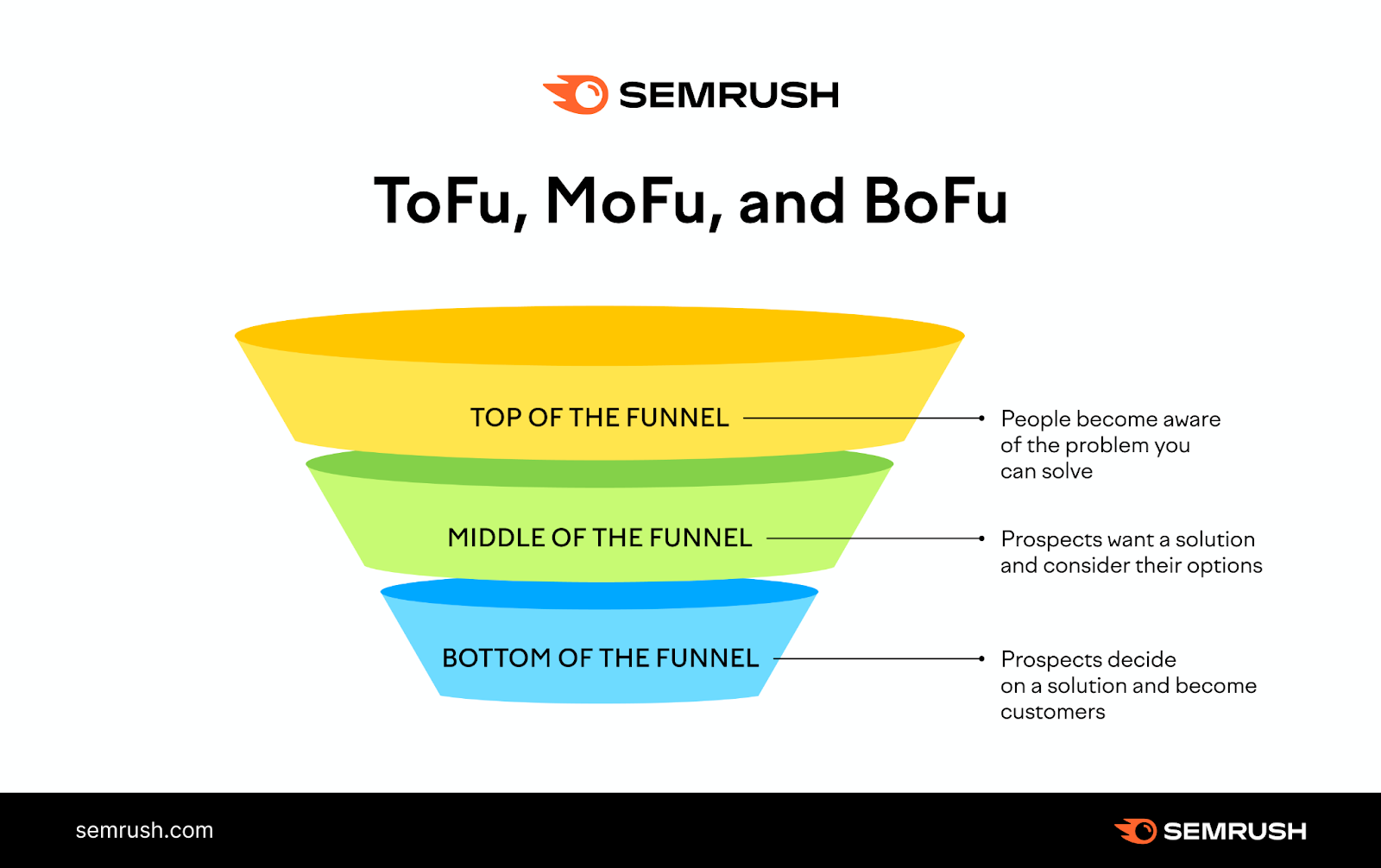
This kind of content aims to win keywords like:
- “How to Solve {Problem where your solution is THE best way to solve it}
- “Best Project Management Software”
- “Construction Project Management Software”
- “Monday.com Alternatives”
- “Trello Alternatives”
These search terms indicate the audience is in the market for a solution in the next 30-90 days.
They’re likely considering options and drawing up a shortlist of companies to book a demo or trial.
What better time to introduce them to your product?
Here are some examples from ClickUp's top pages report (the first column is monthly traffic):
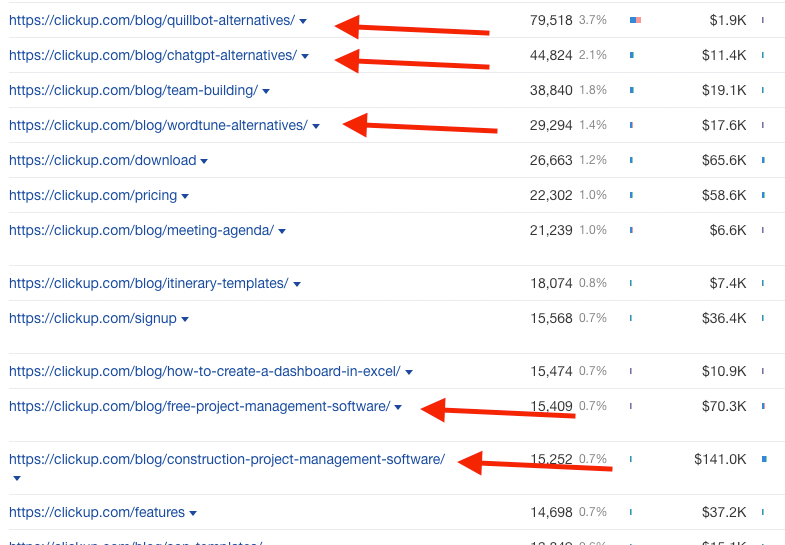
“I tell everyone to focus on the middle first, then go to the bottom, and then go to more top and awareness content.”—Josh Spilker
Evidence suggests there’s a 4.85% to 8.43% average conversion rate for these terms.
Ranking top for these terms should be prioritized in any search-first content strategy.
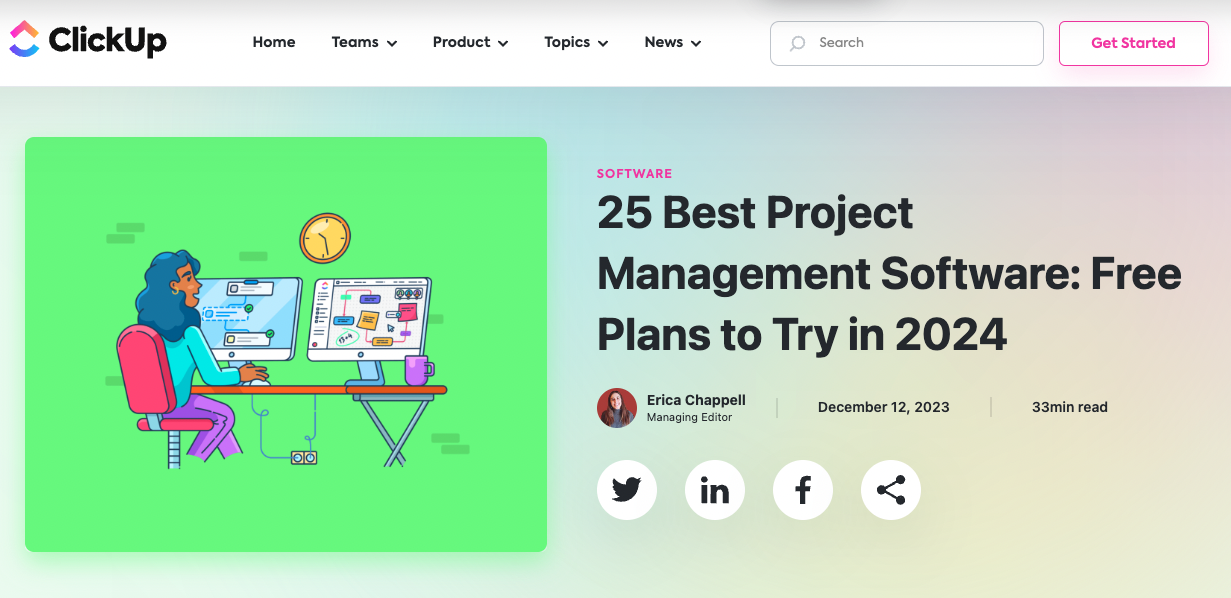
Micro-Case Study - How Josh Got ClickUp To #1 For “Free Project Management Software”
The keyword “Free Project Management Software” has 10,000+ search volume per month and an Ahrefs Keyword Difficult of 58 (Hard).
The average domain rating of the top 10 websites is currently DR 90 (an includes sites like Zapier, Forbes, Trell, and monday.com).
What was Josh’s strategy for winning the keyword (ClickUp now ranks #3 but was once #1)?
Firstly, while Josh didn’t build backlinks, it’s important to remember that ClickUp was still a DR 70 at the time. It’s hard to win competitive terms with a weak authority site.
His work then focused on these three steps:
- Create a listicle post (25+ Best Free PM Software).
- Link to the article in the Footer Navigation (to show prominence and channel authority).
- Create cluster content around it (lots of content on other tools and project management education, all with internal links back to this keyword—a total of 208 internal links).
As mentioned in the introduction, one of Josh’s big takeaways from his time at ClickUp was the discovery that MoFu list posts were very effective at driving product sign-ups.
This is also a strategy we’ve seen work repeatedly in How the F*ck case studies:
- How Monday.com Scaled 600% Traffic in 2 Years
- 6 Steps to Building a High-Converting SEO Strategy
- Hotjar’s 47% Traffic Increase in 2 Years
The strategy is especially effective when there is a lot of demand for your product already.
If there are 100,000 people a month searching for “Best {your product}” you’re in a great spot to try and capture that demand before doing anything else.
However, if you have low demand volume (say 500/month searches) I’d still recommend writing and ranking for these keywords—the ROI is often easy to see.
Imagine this scenario: your B2B SaaS product has an annual price of £20,000. You spend £1,500 creating an awesome “Best {Your Product}” listicle, £10,000 on cluster content, and £10,000 on links to rank #1.
Now, you get just 500 visitors per month reading the article. Over 12 months, that’s 6,000 readers. If 1% of those convert to a paying customer, that’s 60 customers at £20,000 each. You need just one customer to cover costs, but 60 is an ROI of more than £1M in the first year.
It rarely works out so smoothly, so I recommend reducing your numbers to have safe projections). But you do the maths for your product and see if the experiment is worth it.
Is There Any Value to Top of Funnel Content?
With the amount we talk about MoFu and BoFu content these days, you’d think we hate ToFu (sorry for all the acronyms).
So, is there any value in terms like “What is project management?”.
If you're a niche blogger, the value is obvious—they drive traffic and traffic is a key source of your revenue.
But for SaaS content marketers the answer is more nuanced. The conversion rate on ToFu content is very low. It has no intent behind it and is unlikely to drive revenue growth.
However, that doesn’t make it valueless. It just makes it a lower priority on your content roadmap compared to a higher-converting topic.
ToFu content has value in other ways:
- Content conversions (e.g. building an email list)
- Internal linking (e.g. linking to lower-funnel content and driving traffic there)
- Topical authority (e.g. building relevant traffic to establish yourself as an authority in that area)
- Retargeting (e.g. hit the traffic on social media with product ads, etc. A huge benefit is you know what topics they’re interested in)
Not valueless, but certainly not the first content you should write. You should set your expectations clearly about what goals each content type helps achieve.
Scaling the Process - Working With Writers to Achieve Velocity
“At ClickUp, I was writing everything myself. I wrote two posts a week and published those. We had a designer, but I was formatting them in WordPress, doing all the internal linking, and some of the social media as well at that time.
So it was really pedal to the metal, as you can probably tell from their growth trajectory. It's part of the reason I left because it was a really intense environment. But I didn't really ask for help either. That was kind of on me.”—Josh Spilker
In the interview, Josh talked about his shift from “one man” doing all the writing to leveraging freelancers to scale further.
At ClickUp, he wrote two articles a week and published those. But, as the prior quote shows, that route can lead to employee burnout.
In roles at other companies, Josh used freelancers (up to 5 at one point) to scale his work and ship more content, faster.
Stepping out of the weeds (like uploading to WordPress and writing) and focusing on strategic work (like editing and product copywriting) is a key part of systemizing yourself.
I asked Josh what his top tips are for working with freelance writers.
Here are his two answers:
- Create really detailed content briefs
I 100% agree with this. If you have a strong compass for quality and your writers just don’t seem to “get” it, one effective solution is to give detailed, clear instructions.
Josh spends about 1 hour on each brief. He uses Frase to get inspiration for things like headers, includes details on the points he wants to cover, and includes internal links and outside and internal research he wants written about.
The upfront work of owning the strategy behind an article and creating clear instructions for writers saves time later in the workflow. Your expectations for structure and angle will now be met 99% of the time, cutting editing time by hours.
“I try to take away as much editing from the start. Detailed briefs really help with that.”—Josh Spilker
- Don’t let writers write about the product unless they’re in-house
Josh notes he does this because “it takes away from the word count and they don’t know the product as well”.
So for tools and software listicles, he finishes the pieces as the editor with his perspective and detailed product insights.
This means the product expert (the in-house writer) owns the use cases and pain points presented to the reader.
Josh also noted he has templates to use for product copy which he can drop into various posts, as well.
Overall, the onboarding process for new writers is reduced and de-risked.
What’s Josh’s Secret Sauce?
Velocity. Publish as much as you can, as fast as possible. Just get content live as fast as possible.
Why?
- Google will take you seriously
- Your feedback loop will be shorter
- You’ll get more results, faster
I would add that Josh has extensive experience in content so taking a velocity approach doesn’t hamper content quality. I would recommend starting with lower volumes, understanding your workflow, developing an eye for “quality” content, and then scaling your content systems.
A Final Note
A massive thanks to everyone who purchased the Scale Package, feedback is still rolling in and I'm relieved that people are loving it.
My goal in 2024 is to help 10 companies turn search into their #1 revenue channel.
I've stress-tested my strategies and operations, and they work. Really well.
Do you want to scale search as a growth channel in 2024 but don't have the time or skillset in-house to do it?
I can help with that.
I typically work with companies to build quality middle and bottom-of-funnel content (similar to the strategy mentioned in this case study).
I have three packages:
- Consulting: I guide your team to build a high-converting strategy and/or scalable content operation (it's ~$499/hour).
- Strategy & SEO Done-For-You: I dig deep into your industry, craft you a winning strategy, build your roadmap, and each month create content briefs that tell your writers exactly how to win.
- Everything Done-For-You: I build your strategy and my writing team (they're literally the best writers going) executes it all for you. From content briefs to uploading it on your blog—we've got it covered.
For package three, you don't need a single content person in-house and I'll help you turn search-first content into your biggest organic revenue driver.
Email me at ben@thefxck.com or on LinkedIn to set up an intro call.