

This week, Benji Hyam from Grow & Convert joined the community to talk SEO.
His team builds high-converting SEO strategies for a host of incredible companies like:
- Patreon
- Aura
- LeadFeeder
- and Smartlook
In the case study below, we learn the 6-step strategy behind Cognitive FX's SEO engine, which now:
- Drives 50% of all client consultations
- Took them from 0 to 250,000 monthly organic visitors
- Helped beat competitive sites like WebMD
Things You'll Learn
- How & why Grow & Convert charges $10K for 3 SEO articles (SEO agency owners, there's some great advice here for you)
- How to create a revenue-generating SEO strategy (from customer research to prioritizing keywords)
- How to hire the best of the best writers (the extensive funnel used by G&C)
Case Study Background
Cognitive FX is an innovative medical treatment center for people with Post-Concussion Syndrome (PCS).
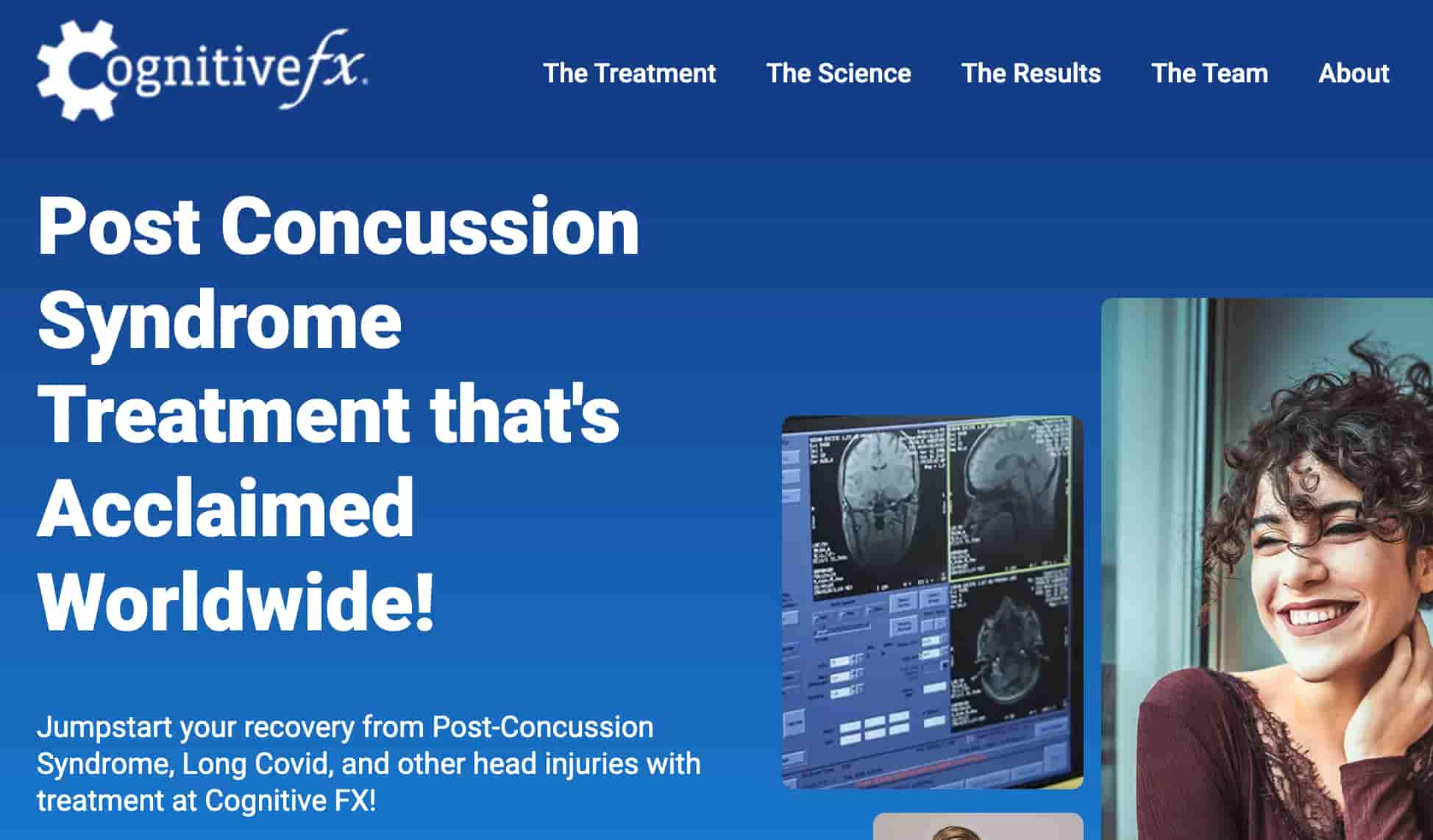
Most people don’t know they have PCS. It’s characterized by symptoms like constant headaches, depression, nausea, and many that occur long after a concussion has gone.
Until they reached out to the Grow & Convert team, CognitiveFx had been growing through doctor referrals and word of mouth from ex-patients.
But, their content & SEO strategy was going to be a challenge:
- Fierce competition: Sites like Healthline, CDC, and WebMD are SEO giants
- Difficult access: Treatment is done in person in only one location
- Unaware readers: most sufferers have never heard of PCS, they just know they’ve got a long-lasting headache
Despite the seemingly high barriers to success, Benji and his team grew Cognitive FX’s blog to 250,000 monthly visitors and their content strategy is now responsible for 50% of new consultations.
In this week’s SEO case study, we’ll find out exactly how the team at Grow & Convert did it.
6-Steps to Building a High-Converting SEO Strategy
Let's dive in.
1. Start with customer research

Benji recommends starting every new SEO strategy with customer research.
That means talking to people in your company with the closest relationship with your customers:
- In enterprise SaaS? That’s typically your customer success team.
- In services or product-led SaaS? That’s typically your customer support team.
With Cognitive FX they talked to the doctors at the treatment center to find out:
- Common patient symptoms
- How those symptoms appear
- How they got these symptoms
- What patients have tried before?
- What do they know/don’t they know?
This stage helps you understand the critical nuance behind the problem being solved and the customers who needed the solution.
2. From Customer Insights to Relevant Keywords
In the second fundamental stage of SEO research, we need to look for keywords that reflect the pain points of our ideal customers.

“We coined something called Pain Point SEO, which essentially is just going after high intent pain point related keywords that you find that out through customer research.”—Benji Hyam, How the F*ck SEO Podcast
Benji's customer research process with Cognitive FX revealed that people who’ve suffered from just one concussion typically aren't potential customers.
This meant that targeting keywords like “concussion treatment” or “concussion” would target the wrong audience.
Instead, people likely to suffer from PCS have had multiple concussions and are experiencing long-term symptoms from them.
With this in mind, it became clear that the audience with the highest conversion potential would be searching for terms like:
- Cause: “multiple concussions”
- Symptom: “post-concussion menstrual cycle changes”
- Symptom: “post-concussion stomach problems”
- Symptom: “post-concussion heart rate Increase”
- Symptom: “concussion headaches”
People searching these terms may not know they have PCS, but they’re aware of their problem and are actively seeking a solution—dramatically increasing their conversion potential.
3. Prioritize Keywords Based on Their Intent
Grow & Convert’s philosophy is to prioritize keywords based on buyer intent.
“We target keywords that indicate people have high buying intent first, before moving “up the funnel”.”—How to Prioritize Based on Intent, Grow & Convert
There are typically three categories of intent-based keywords:
- High(est) Intent: Product or service category keywords (Example: “post-concussion syndrome clinic”)
- High Intent: Competitor comparison keywords (Example: “best concussion clinics in US”)
- Medium Intent: Pain point keywords (Example: “headache after concussion”)
“We prioritize intent over search volume, even for keywords that show low or zero search volume.”—How to Prioritize Based on Intent, Grow & Convert
To spread your bets, Benji recommends diversifying your keyword targeting with a mix of difficulties, traffic volumes, and intents.
“We always start with the bottom of the funnel and work our way up the funnel for a few reasons. One, as an agency, we're held accountable to conversions. We're held accountable to the same metric that the person's hiring us for, so we don't really care about traffic.
At the end of the day, the businesses are gonna continue working with us or fire us based on the [revenue] results that we drive. And so from a business perspective, it makes sense to go after keywords that would indicate that someone's most likely to purchase first and then work your way up the funnel.”—Benji Hyam, How the F*ck SEO Podcast
Focusing on bottom-of-funnel keywords first, prioritizes conversions and revenue over organic traffic.
4. Build Topical Authority Through Expertise
You may be thinking at this stage, what about topical authority? Isn't it important I cover the full funnel of keywords?
Benji notes that he cares less that the content library covers “every” keyword available on a topic and more that it collectively shows expertise on the topic.
The Cognitive FX blog shows topical expertise by:
- Interviewing a doctor for every article
- Consistently writing about the same topic (concussions and symptoms)
- Writing useful content on this topic that no one else is writing
I often recommend on this blog that SEOs focus less on covering all the keywords on a topic and more on creating a valuable resource on a topic.
The three key elements of Benji’s strategy fit that advice well. Not only is the content expert-driven, but it’s consistently useful for the same audience.
If I had post-concussion syndrome, I know which blog I’d be devouring.
5. Create Quality Content That's Differentiated
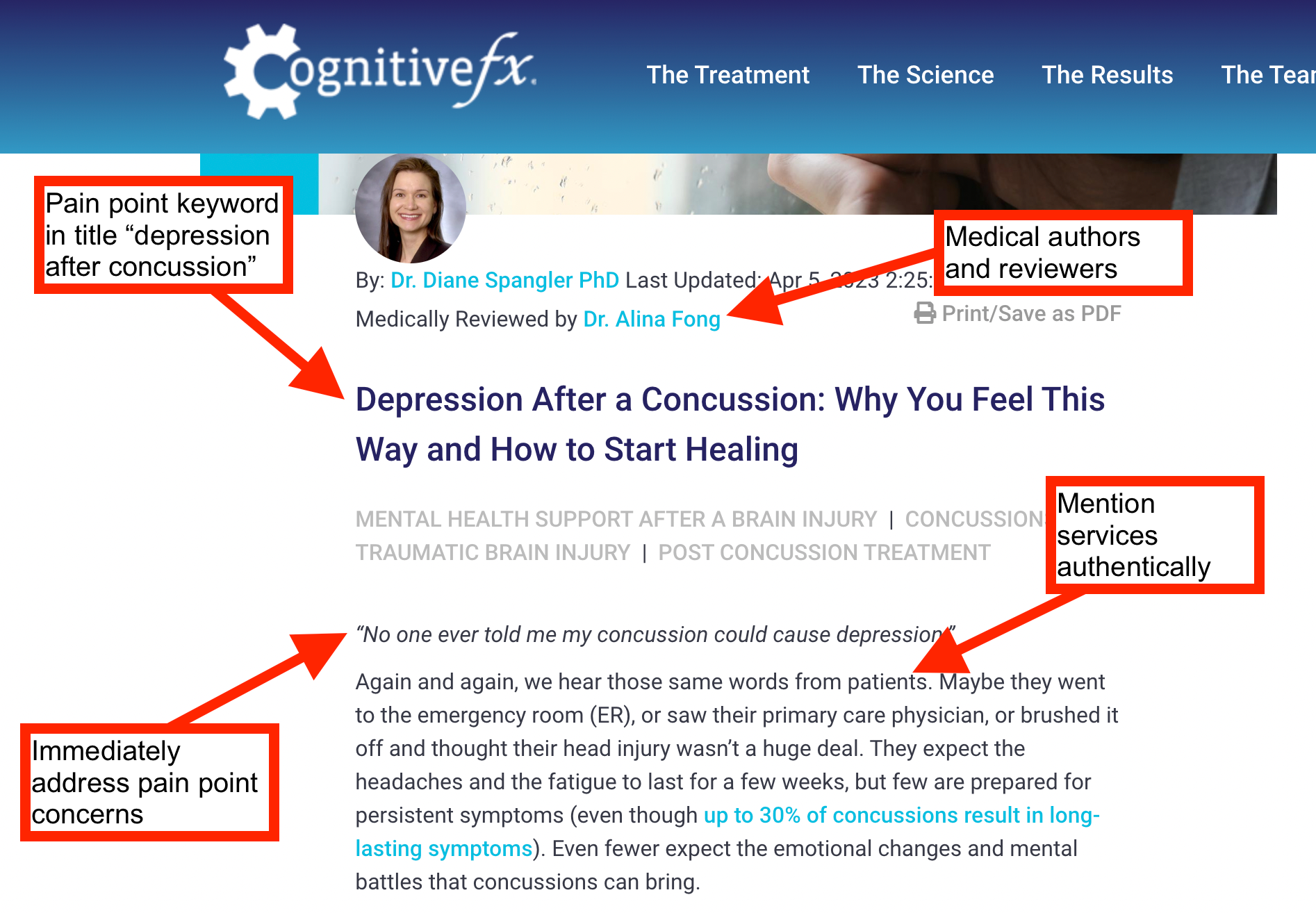
As I mentioned in point 4, Grow & Convert’s approach to content is to interview a subject matter expert for every article.
This ensures content:
- Displays Information Gain (and is not “copycat” content)
- Brings internal expertise to content (displaying their thought leadership)
- Has a unique point of view
“We're able to interview the doctor who has a really unique point of view, and can say ‘Hey, here's what's wrong with the way that everyone else is treating concussions and here's how we're different.’ That's what's really needed to convince people that your product or service or whatever you're selling is better than anyone else is having the unique company's point of view into the content. Interviewing people is a key part to that process.”—Benji Hyam, How the F*ck SEO Podcast
Not only does running a 30-60 minute expert interview create quality content outcomes, but it saves time, too.
Writers have to do less research, they hit the ground running with a clear point of view to embed during their writing process.
6. Create Content that Matches the Audience
Typically, people with Post-Concussion Syndrome (PCS) have been treated for a concussion already and it didn’t work.
They’re skeptical readers.
So, the content needs to reflect this. It needs to address what the reader already knows and put their worries at ease.
A worried reader needs content with an overweighting of:
- Expert insight
- Quality authors
- Examples & stories
Benji offers an example that illustrates this point perfectly:
“Let's take an example of someone who's had concussions. They're definitely not gonna know as much as a doctor, but they're not beginners. They're not just researching concussions for their first time. They've likely had concussions for years. They've seen multiple doctors, they've been to multiple clinics. They're coming in with like a pretty decent knowledge level about concussions.”
“If your writer is treating them like they're someone who doesn't know anything about the topic, and the writing comes across like the author doesn't know what they're talking about, you're not gonna be able to convince the reader.”—Benji Hyam, How the F*ck SEO Podcast
This advice was echoed by Lily Ugbaja and her LEMA framework, which I highly recommend that everyone creating content reads thoroughly.
FAQs From the Interview

How do you get experts to contribute to content?
Grow & Convert make sure it’s a requirement in the sale process: the team will give access to internal experts.
For most of their clients, it’s not a huge undertaking. The writer spends 1 hour with an internal expert per article, which comes to 3 hours a month.
How do you find writers who deliver such high quality?
Benji said,
“I won't lie. This content is extremely difficult to produce. So just on our own side, hiring someone who can write like this is extremely challenging.
I would say that's been our biggest bottleneck as an agency since the very beginning. We've had more demand than we can handle operationally because on the operations side, producing this kind of content is really, really, really difficult.”
But, why should you do it? Benji notes, “Because it produces way better results” which keeps your clients for longer.
Do you use freelancers? What’s your hiring process?
All Grow & Converts writers are freelancers. But they’re all part of the team.
Each writer goes through an extensive application process:
First assessment:
- Samples
- Quick writing prompt
Second assessment:
- Paid test project
- One round of feedback, how do they improve from feedback?
Third assessment:
- Paid test on a real customer account
- Paid test on another customer account (test their ability to switch subject matters)
Only then will they be brought on as a full-time writer.
Your content costs $10,000 a month for 3 articles, how do you justify it?
“If I look at the content that most people produce on the SEO side, it's trying to take shortcuts.”
Benji notes that most agencies ask:
“How can I create content for as cheaply as possible.”
When they should be asking:
“How do I produce the best content possible.”
Grow & Convert charges a lot for content services, which allows them to invest in a quality content production process.
“From a cost perspective, yeah, it's not cheap in terms of what we pay writers to do this and strategists on our agency and even the cost of our own service: we charge $10,000 a month to do this for three articles a month.
But again, we're not selling the articles as much as we're selling the results. We don't go in and say, here's the cost per article. We say, how many keywords do you wanna rank for? And if you were to rank for these, how much business would that drive for you? That's what you're buying from us.”
Benji mentions that the clients his team works with are focused on long-term results and conversions, not cost per article and quick traffic results.