

This week, Benji Hyam from Grow & Convert shared his 6-steps to building a high-converting SEO strategy.
It was awesome.
I love coming across people with such a huge focus on quality content and revenue outcomes.
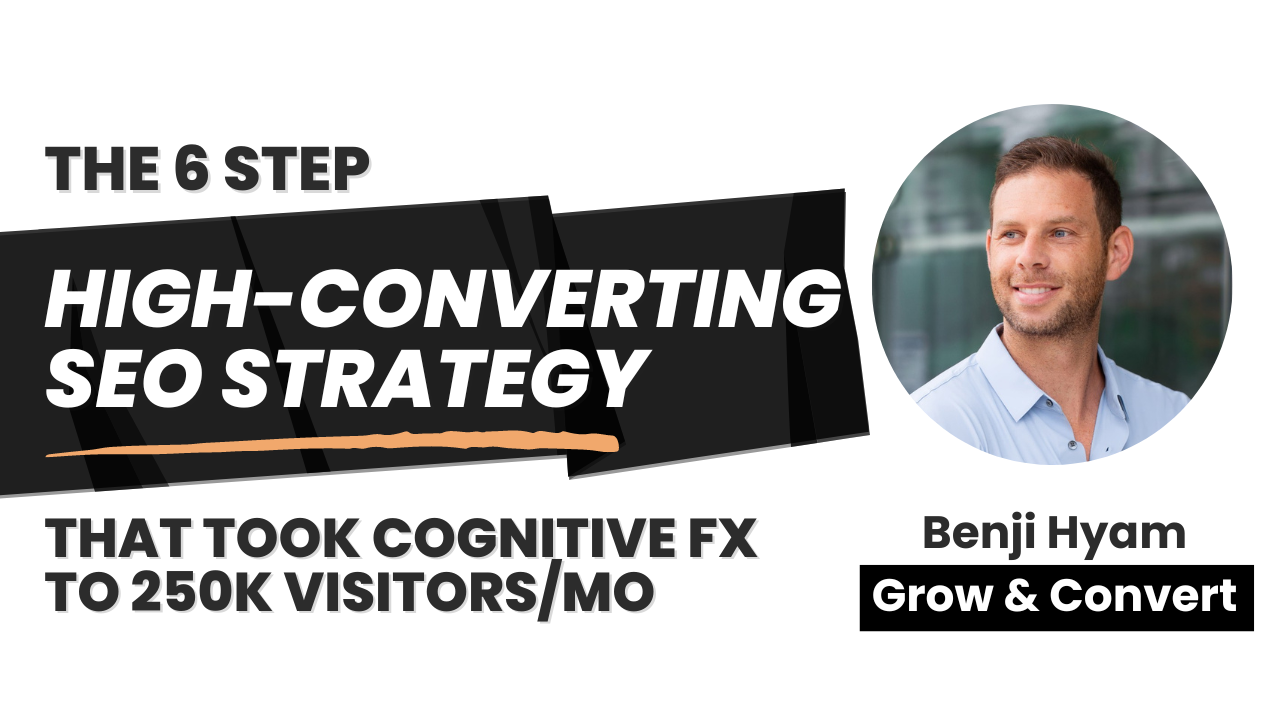
In this week's newsletter, I want to expand on one point in particular: what makes a piece of content convert?
Now that AI-written content is becoming widespread, we have to ask ourselves what kind of content will actually work, and why.
There's so much to explore here.
So, let's break down one of the articles Benji's team wrote for the healthcare company, Cognitive FX.
I'll cover:
- 7 elements of a high-converting article
- Why those are so effective (there's a lot of psychology involved)
Let's dive in!
The Anatomy of a High-Converting Article
For this analysis, I’ll break down this article:

1. It targets pain points
Cognitive FX treats something called Post-Concussion Syndrome.

The characteristics and symptoms are specific, and Cognitive FX’s content targets those symptoms in particular.
Readers are:
- Looking for a solution
- Have a problem Cognitive FX can solve
Catching someone in the midst of a really challenging pain point is a prime opportunity for conversion.
2. It has authority authors (and reviewers)
This is a medical issue. Readers need to trust the source of information.
Grow & Convert interviews a real medical specialist in this field for every article.

Interviewing experts ensures all content is:
- Differentiated
- Reassuring
- Helpful
The article shows off Cognitive FX's authority and positions them as the 'expert guide.'
3. It builds reader connection
The article starts off in one of the most compelling ways I’ve seen.
- It quotes a real patient.
- It then goes on to describe what a “typical” patient goes through.
This quickly helps the article:
- Hook
- Connect
- Resonate

This is an excellent case study for leveraging customer insight within content.
If the reader has gone through something similar, I can only imagine how much this introduction would resonate.
4. It addresses search intent
The article is educational. It teaches about the core subject and everything else the user needs to know on the topic.
Not only does this build trust (we tend to overweight trust toward our teachers), but it meets the reader where they’re at.
We as humans need to understand before acting. It goes Pain → Understanding → Solution, not Pain → Solution.
(This article wouldn’t rank well without target search intent, either. So understanding what would be truly useful to the reader and delivering that is even more important.)
5. It’s in a digestible format
Cognitive FX is filled with:
- Charts
- Tables
- Images
- Graphics
- Subheadings
I’d argue the images could be more relevant, but they keep the content digestible and less overwhelming.
6. It offers a logical next step
In my interview with Jacob from NerdWallet on high-converting keywords, we talk about the “by the way” call to action.
Most articles write about a topic, then in the conclusion say “by the way, we have a product, book a demo here to check it out”.
This is unconvincing and an easy-to-ignore way to go about it.
Instead, Cognitive FX talks about “their patients” and “clinics” throughout the content. They also offer a logical next step: a full article on how to treat Post-Concussion Syndrome(PCS).
Matching the conversion point to the reader’s place in the “buyer journey” dramatically increases conversions.
Side note: this is a natural benefit of building topical authority. Internal linking to relevant resources is natural.
7. It explains how, not just what
They do also explain treatment options that Cognitive FX delivers within the article.
And, importantly, they don’t just say “reach out to us, we can help you”.
Instead, they:
- Have a quiz for readers to “find out if our treatment is right for you”
- Explain thoroughly what treatment looks like and how it works
I think this last point is important.
It’s common to hear the advice these days that we should talk about “benefits, not features”. But when your audience is intelligent and informed (as most people tend to be about their own health) I believe that advice is misguided.

If you only talk about the benefits of treatment, you forget that it’s important for us to know how we can achieve those benefits.
Then we can assess: Is it hard? Can I trust it? Is it for me?
——
If you found this post helpful, please help me grow by sharing this article on social media or recommending the newsletter to a colleague.
Hope you have a lovely week,
Ben