
This week I welcome Gaetano DiNardi back to the community to talk us through an insanely successful SEO growth story he oversaw.
He's one of the best in SaaS growth, advising the likes of Gong, Cognism, and Alyce on how to generate and capture demand.
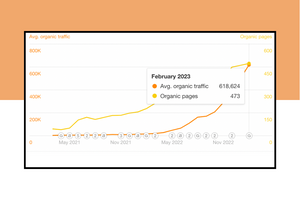
In 2022, he joined the digital safety app, Aura, for 9 months. In that time, they shifted from zero content to (close to) 1 million monthly visitors.
In this week's case study, we find out the thought process, strategy, and execution tips behind how they did it.
Expect to learn:
⚡ Why introductionless content is the next big thing in SEO.
⚡ The type of content brands are sleeping on and how it helps with SEO.
⚡ Aura's keyword strategy (and the thing brands often do wrong).
⚡ Aura's blog content: a teardown of why it's so successful.
⚡ Gaetano's backlink-building tricks and tips.
Background
Summary:
Gaetano joined Aura in late 2021. Since then, there have been around 100 additional pages added to the website.
Their strategy focused on creating content that closely aligned with their product value. For example, they created 55 blog posts detailing potential scams across different apps and websites—and those blog posts generate over 200,000 hits a month today.
Over the last year, the Aura website gained 1,000s of backlinks. Some organic, through "buzzy" content, some through PR, and some through networking on LinkedIn (more on that later).
Results: With just 20 articles a month, Aura grew rapidly to ~1 million monthly clicks.
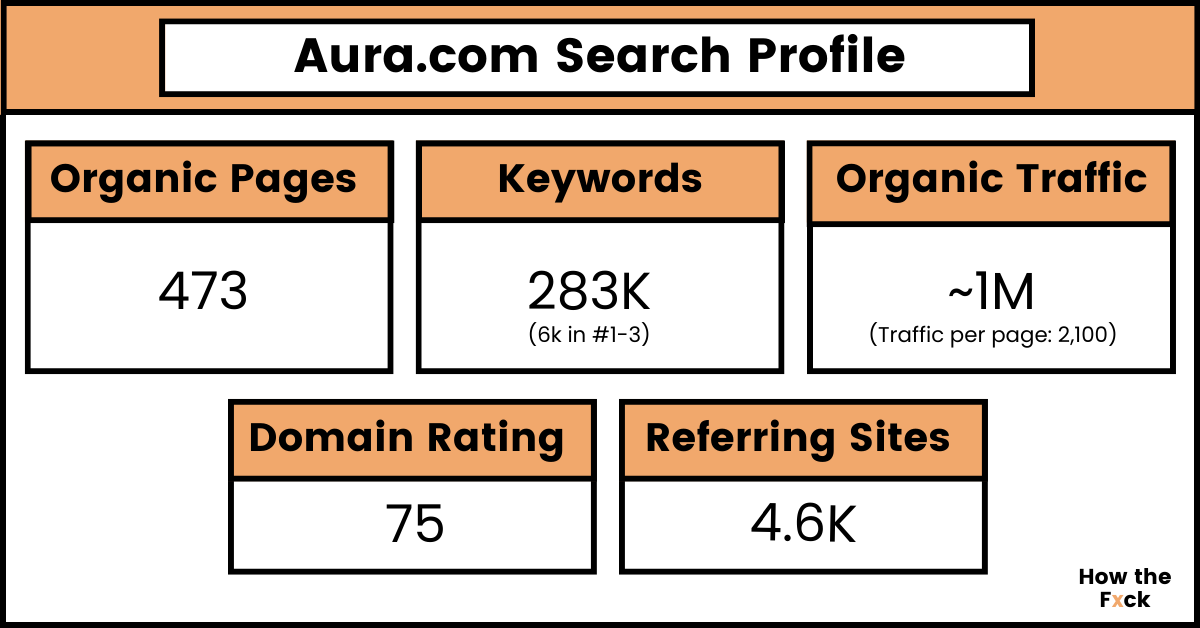
Quick stats:
Starting point:
- 0 website content, only homepage, pricing, feature, and solutions pages
- ~0 monthly organic traffic
Content produced:
- 20 articles per month
- Why 20? They were playing catchup. Aura competes against HUGE players in its niche. This volume would also help them ensure good editorial quality for a team of their size.
Results:
- Close to 1 million monthly organic visitors in just 12 months!
- An outstanding traffic per page of 2,100
Let’s take a look at how Gaetano and the Aura team put together this winning content strategy.
Why Aura Chose SEO As Part of Their Growth Mix
I love asking this question to guests. Understanding the "why" behind SEO is a fundamental question people need to ask before investing in it.
Gaetano gave us four reasons Aura needed SEO as one of its major growth channels for several reasons:
1/ Educating the target audience
The topic of digital safety, identity theft, online scams, and similar is still a fairly foreign concept to many.
The market has a strong need for educational content, and Aura was ready to provide that.
2/ Creating multiple touchpoints with potential customers
“People don’t buy right away. They have to see a marketing message a lot before they take action on something like identity theft protection. Unfortunately, most people don’t think they need it. Until it’s too late.” - Gaetano DiNardi
High-quality content allowed Aura to not only increase awareness of a problem its audience didn’t know it was having but to also encourage them to act and solve that problem.
3/ Aligning the company mission with consumer needs
Aura’s company mission is to educate and protect entire families from various online risks.
SEO allowed them to align this mission with the needs of their consumers.
4/ Reducing acquisition costs
Aura was spending a lot of money on paid marketing, such as influencer marketing, search ads, and similar.
“They realized, Well, we can’t grow this thing just on paid budget, because we’re gonna go bankrupt. That’s definitely another reason why we decided to go hard on SEO and content.” - Gaetano DiNardi
Aura’s Keyword Strategy - Full-Funnel Approach
The digital safety industry is highly competitive, with big names such as McAfee, Norton, Experian, and TransUnion looming over smaller players like Aura.
Gaetano usually recommends focusing on bottom-of-the-funnel content. But because Aura had catching up to do in such a competitive industry, the content was built to catch the audience across the full funnel.
“Because Aura was a newcomer in a crowded space, not only did we need new customer acquisition, but we needed to actually get the brand out there.” - Gaetano DiNardi
This allowed Aura to build much-needed topical authority and to build brand awareness, so they could later capture a bottom-of-funnel audience, too.
Here’s what this full-funnel content strategy included.
1/ Uncovering long-tail keywords ideas from customer calls
Gaetano spent an entire month at Aura listening to customer support calls and pulling keyword ideas from them.
“Through [the calls] is where I uncovered the most revealing insights, things that you wouldn’t find in a keyword research tool.” - Gaetano DiNardi
Keywords like "Dark Web" are too competitive to win off the bat without existing topical authority. But longer tail keywords (like common questions, pictured below) are typically low difficulty and a great place to start gaining traffic.
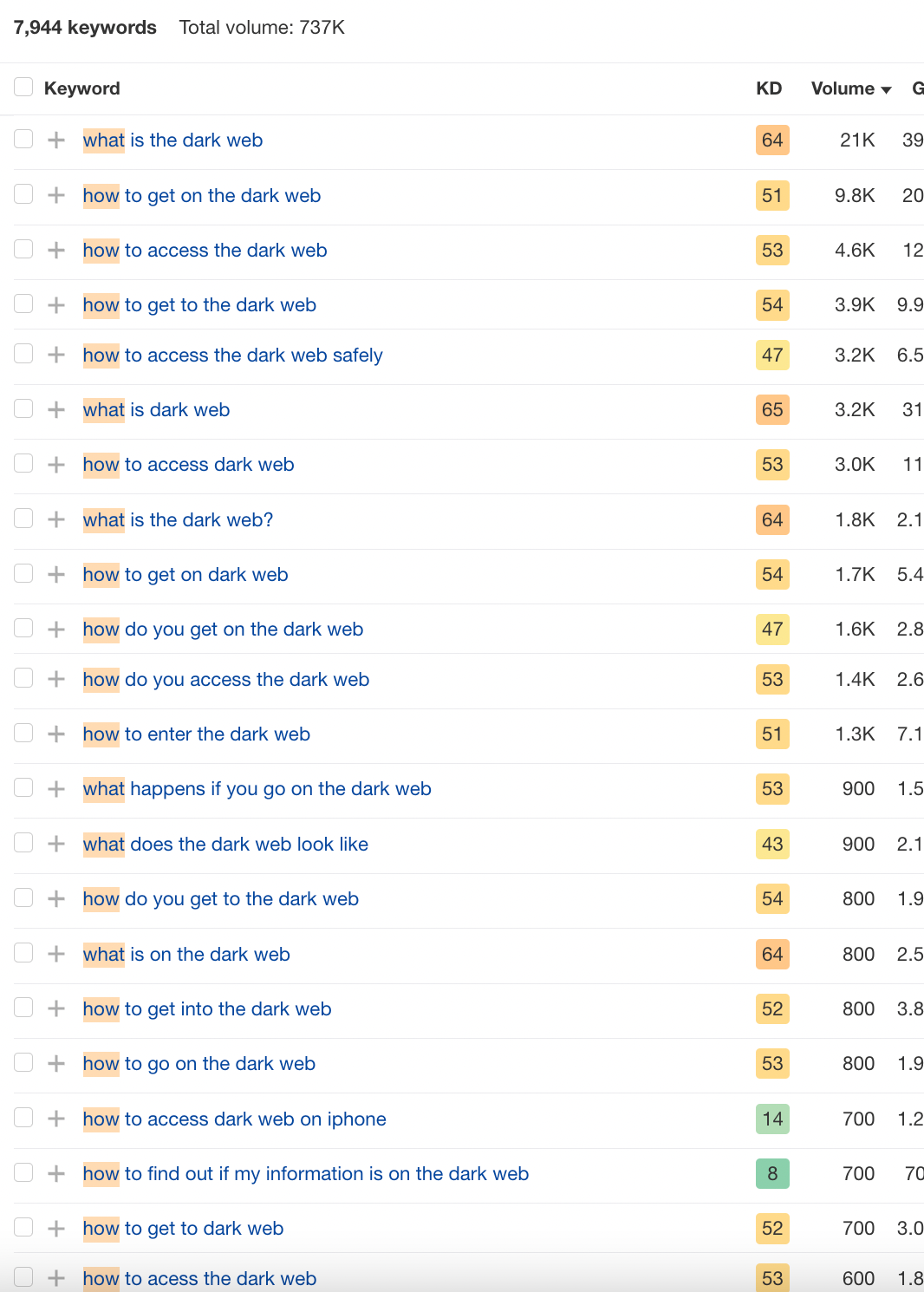
Gaetano’s customer calls helped him discover what questions customers were commonly asking, so his team could focus on those to start with.
“On a sales call, you’re gonna hear an old grandma call and say things like, ‘I just got an alert from the dark net, what do I do?’ Or ‘I think my social security number is on the dark net.’” - Gaetano DiNardi
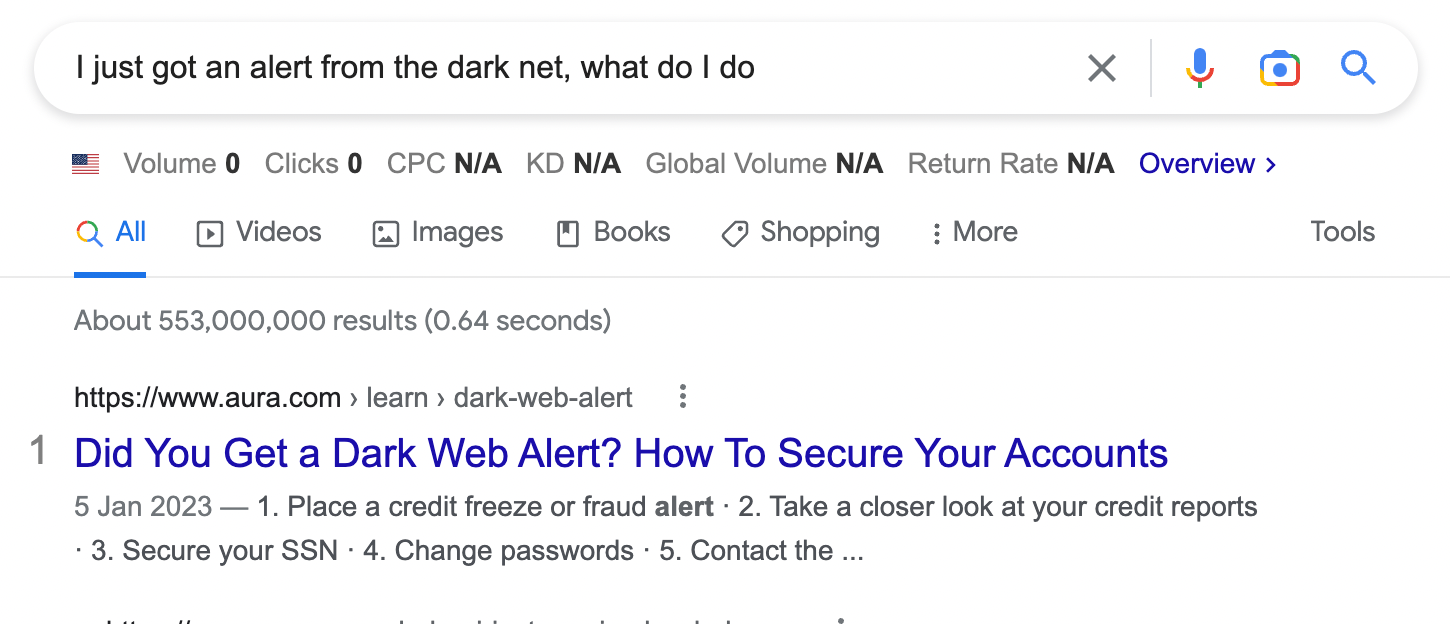
These questions can then be turned into keywords such as:
- Social security number found on dark web
- Dark web alert what does that mean
- What can a scammer do with my ________
- Can someone steal my identity if they have my _______
Gaetano also used the help of Google’s autosuggest to formulate his customer insights into these long-tail highly-relevant keywords to target.
2/ Developing content on ‘buzzy topics’ to drive backlinks.
The Aura team built content around ‘big buzzy topic’ because they were naturally interesting and would drive organic backlinks.
Typically, buzzy topic content includes:
- Original research on industry trends and statistics
- Deep-dive teardowns (case studies, much like the ones we do here)
- Infographics
- Lists of useful tools, especially if they are free, etc.
Gaetano and his team analyzed Aura’s competitors to find the pages driving the most backlinks to their sites.
“We saw that the big buzzy topics like The Newest Scams That Are Happening On Zelle - those tend to get tons of natural links just because it’s a big buzzy topic. And it’s still relevant to our audience. We wanna educate people about the dangers that are happening on Zelle.” - Gaetano DiNardi
So Aura started doing detailed breakdowns on scams on many different platforms, such as Walmart, AirBnB, Paypal, Venmo, etc.
These types of pages are also great for repurposing content for social media, which is super important in direct-to-consumer (D2C) marketing.
Here is an example of one such piece of content that generated 70+ backlinks for Aura:


Finally, what were the overall results of this approach?
Aura’s Domain Authority jumped in late 2020, just before Gaetano joined the team. PR activities doubtlessly had a lot to do with this.

At the same time, in the year since Gaetano joined, the number of referring domains increased by 4000.

While PR still had a role in these results, it’s clear that buzzy topics do their magic as backlink magnets.
3/ Identifying the core problems to solve
To round out the full-funnel content strategy, Gaetano worked on connecting the backlink-driving buzzy topic pages with pages that actually helped Aura’s customers solve their problems.
“We basically just used [buzzy topics] as portal pages to get links and massive traffic and then funnel internal link juice to pages we wanted to rank for.” - Gaetano DiNardi
The real ‘money pages’ of Aura’s strategy are those that solve the core issues its customers have.
Pages like these capture an audience with a problem that aligns closely with Aura's product value:
- What to do if you get a dark web alert
- Signs of fraud on your credit report
- How to fix your credit after an identity theft incident
- How to get your money back if you’ve been scammed
With link juice from backlink-rich pages, it wasn’t too difficult for these how-to guides to rank high in search results.
One thing that everyone gets wrong in keyword research 👇
Gaetano is adamant that you shouldn’t be selecting keywords in ways most other people in the industry are.
“It’s ‘Let’s just go for the highest volume, most obvious topics and terms, let’s copy the same style that everyone else is doing, what is x, super long form, 7k word guide, try to pump it with links and see where we get.’ All that shit is great, but you’re probably not going to get customers if you do that.” - Gaetano DiNardi
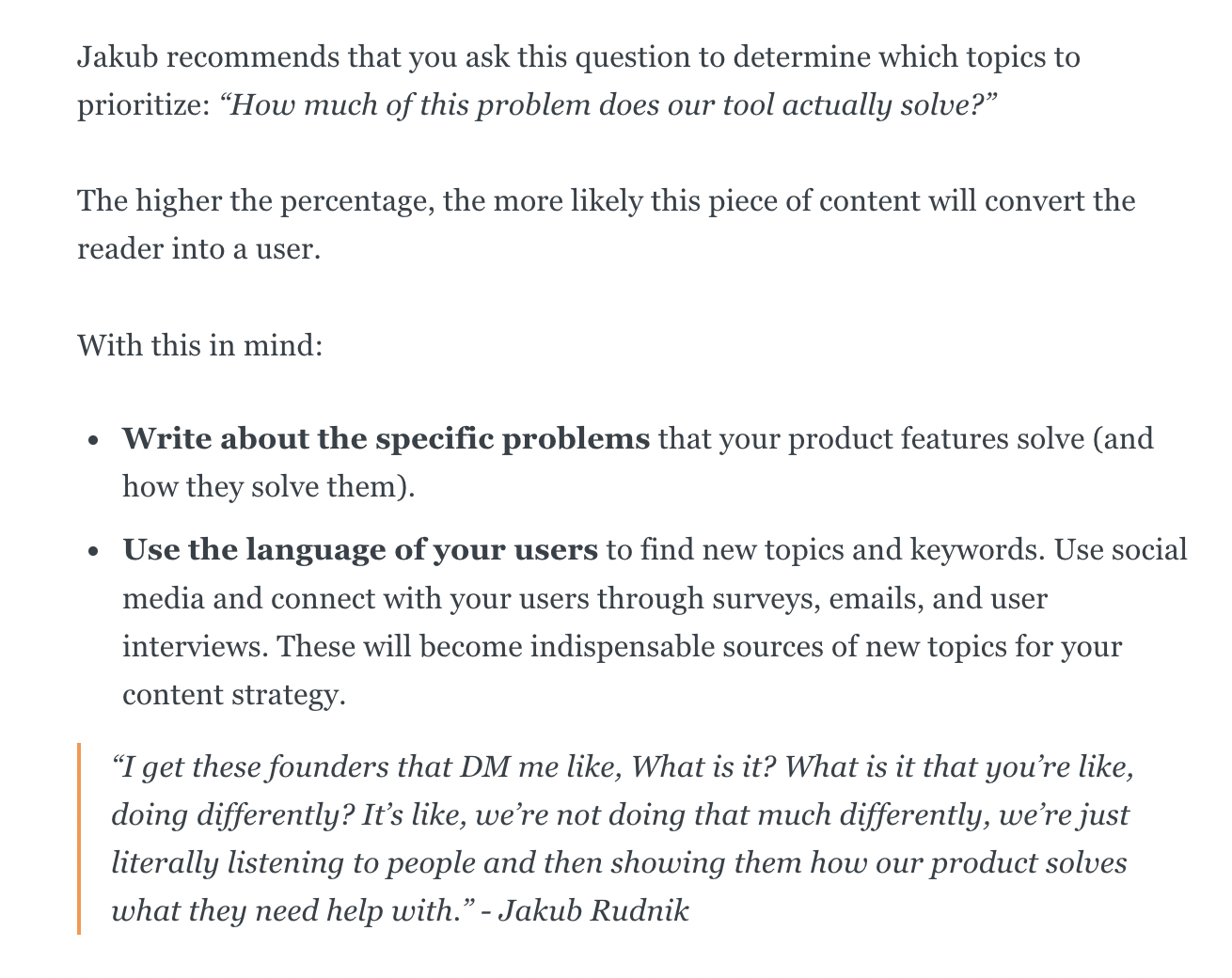
In other words, focus on the core problem your product solves. Choose long-tail keywords so you can write about solutions to that problem.
If a topic is too far away from the core customer problem, you should think twice if it is really worth investing your time and money into it.
Sometimes the answer will be yes, you might need that topic to build backlinks or for topical authority.
But more often than not, you don’t need to target generic, super high-volume keywords that won’t bring in paying customers.
In our case study with Jakub from Scribe, he gives the same guidance:
Aura's Formula for Outranking Any Powerful Website
Aura's growth lead, Irina Maltseva, recently shared this mini strategy guide for Aura.
Aura’s Blog Content - Blog Post Teardown
Let’s take a closer look at Aura’s top pages:

The top page drives around 10% of overall traffic, which is pretty common for SaaS websites.
Gaetano joined Aura in November 2021. At that time, the website had around 360 pages.
Now they have 445 pages, meaning that the growth they experienced came from fewer than 100 new blog posts.

What kind of content did they create?
If we slide Aura’s top-performing blog post under the magnifying glass, we can learn a lot about its structure, formatting, and why exactly it works so well.

Why did Gaetano’s team choose this topic?
- It aligns with Aura’s product value: keeping passwords safe.
- The reader has likely had a negative experience (their Facebook account getting hacked) and they’re interested in protecting their devices and accounts moving forward. They may not be in the buying stage yet, but they are definitely problem-aware.
Title: focused on the pain point, following a clear ‘How To Solve X Problem’ formula.
Format: a step-by-step guide, ideal for this type of topic.

The article is introductionless.
As Gaetano puts it, most content doesn’t need an introduction.
He first discovered it when analyzing the keyword sales training software for Gong.io.
He realized that the top-ranking pages for this keyword got right into the meat of the article without any fluff beforehand.
“Think about it: if [the customer] is searching for sales training software, they already know why they should be using it. They don’t need you to re-explain why they should be using it. They’re here, they’re looking for it, they know why.” - Gaetano DiNardi

Instead of a generic introduction, the article starts off with a heading and personal story which achieves two things:
- Helps the reader connect to the content right away - ‘Yes, wow, this happened to me, too!’
- Creates a sense of urgency - Kelly from the story is losing money because her Facebook account got hacked. We have to resolve this quickly!
Aura uses video to increase value (and time on page)
This article has video embedded into it:

Videos embedded in blog posts:
- Increase time spent on the page.
- Help the reader better understand the topic and what they need to do.
These benefits apply even if you don’t have your own videos to include, such as in Aura’s article.
Aura covers actionable steps to drive value for the reader

The article covers all the important nuances, such as what to do if you still have access to your hacked account.
You will notice that the steps described are super actionable, with clear bullet points and bolded phrases. (This step-by-step could be improved with screenshots—which are missing here.)
Step-by-step guides are typically hard to fake.
The writer actually has to go through the steps themselves to ensure that they will lead to the right result.
This adds E and E (expertise and experience) from Google’s E-E-A-T, the guidelines ensuring that the content you create is truly helpful to the reader.
Aura's CTA

For conversion: Aura has a floating CTA on the side, visible at all times.
It captures the readers who are ready to buy while at the same time not disrupting the experience of those just seeking to recover their Facebook account.
I really like this kind of CTA. I'm seeing it on more and more SaaS blogs. I think it means you can focus on content quality, and simply advertise your content without forcing your product into every article.
The What Next Section

Good content answers the search intent (here "what to do if your Facebook is hacked"). But great content goes one step further and gives the reader what else they need to know.
Aura's article does that here with a section on staying safe in the future.
From a pure SEO standpoint, these additional FAQ sections also pick up extra keywords the article can rank for.
Aura includes a free tool as a "next step" for the reader - the immediate CTA

Aura also includes its own relevant, completely free tools that the reader can make use of.
(Free tools are great for backlink building, if you remember from our previous section.)

Finally, the article ends with a CTA and an offer for a free trial for those who are interested.
Interesting bits about Aura’s content
1/ Many articles include a corresponding YouTube video.
Example: This article about Venmo scams and its corresponding YouTube video is embedded in the text.

Aura’s editorial content strategy was mirrored by its video marketing (YouTube) strategy.
The benefits of this are:
- Building a more cohesive multi-channel content engine (blog posts, YouTube, social media shorts, email, etc.).
- Improving the connection with the target audience. Video is much better at conveying emotion and relating to people than display ads.
- Blog posts with embedded videos rank better.
“When we started doing the embed move, not surprisingly, our rankings increased, and our traffic increased and our engagement increased as well.” - Gaetano DiNardi
Video repurposing:
- Thanks to YouTube’s heatmap feature showing sections of a video that are the most popular, Gaetano’s team had no trouble selecting which parts of a longer video could be repurposed for shorts.
- For the content engine, these shorts were then embedded in blog posts, email newsletters, and posted on social media channels.

2/ They targeted a lot of “scams” keywords.

Aura’s strategy didn’t include any programmatic SEO, but targeting a lot of similar keywords has one clear benefit: the opportunity to create content templates.
Content templates allow for faster content creation without sacrificing content quality.
From the picture above, all of the ‘scam’ pages can follow the same basic outline:
- What Are X Scams?
- The 15 Latest X Scams
- [FAQ Section] Were You Scammed on X? Here’s What To Do!
Additionally, ‘scam’ keywords target users who likely didn’t get scammed but are interested in protecting themselves. They help the content align with product value and increase the conversion rate.
Gaetano's Secret Sauce to Great Backlink Building
“I don’t waste my time doing cold email outreach ever. I haven’t sent a cold email for link building in many years.” - Gaetano DiNardi
Instead of doing cold email outreach, Gaetano had focused on building his reputation, his network, and his personal brand.
This is why, for link building, he can just hit people up on LinkedIn for favors or collaboration.
This method works because:
- On LinkedIn, as opposed to email, everyone can immediately check his credentials.
- It helps him find relevant websites and people in his network who work at good domain companies, earning him high-quality backlinks.
Gaetano mentions other effective methods for building backlinks, such as:
- Guest posting
- Being a guest on podcasts
- PR teams for bylines on big sites
Here's an example backlink the Aura team built:

This backlink was built through networking on this article, What Is The Deep Web?
How do I know it was a built backlink?
The anchor text to Aura’s page is too much of an exact match. Why would a writer add this naturally, especially to a competing page on the same topic.
What’s Your #1 Piece of Advice for SEOs Today?
Gaetano emphasizes that you shouldn’t lose sight of the fundamentals of today’s SEO:
- Listening to customer calls and doing thorough customer research.
- Uncovering pain points, the deep levers to pull for a prospect to become a paying customer.
- Interviewing subject matter experts (SMEs) who can provide original, unique insights to your content.
- Adding a unique twist or a different angle to a topic - setting your content apart from what’s already in the SERPs.