
In this article, you'll find the full strategy and the details of the Foundation-Growth-Scale SEO framework.
This week my guest on the podcast was none other than Maeva Cifuentes from Flying Cat Marketing.
In the episode, Maeva shared with me how she and her fast-growing team quadrupled (4x!) the revenue of property automation software company, Operto Guest Technologies in just 12 months.
In the case study, I'm going to detail the SEO framework that she used at Operto and explain why it worked so well.
What I’ll cover:
- Operto's background
- Flying Cat’s three-part SEO framework (Foundations-Growth-Scale)
- What a topic cluster model is and why it’s important
- Four quick-fire SEO techniques
This is one of the best step-by-step playbooks for guaranteed inbound growth I've seen in a while.
Here's a glimpse of what's to come from the case study.
I really enjoyed breaking this one down👇
Who is Operto?

Operto Guest Technologies was founded in 2016 and now has around 50 employees.
As a property automation software company, they mainly service hoteliers and property managers.
The company's system integrates IoT support into one place for real-time portfolio management and viewing.
Case study overview
The target market: Hoteliers and property managers
The issues:
- Operto was very sales-led, but needed more sales
- They had no dedicated marketing department to leverage
- They had a clean website with no content
The goal: 3x revenue in 12 months
The strategy:
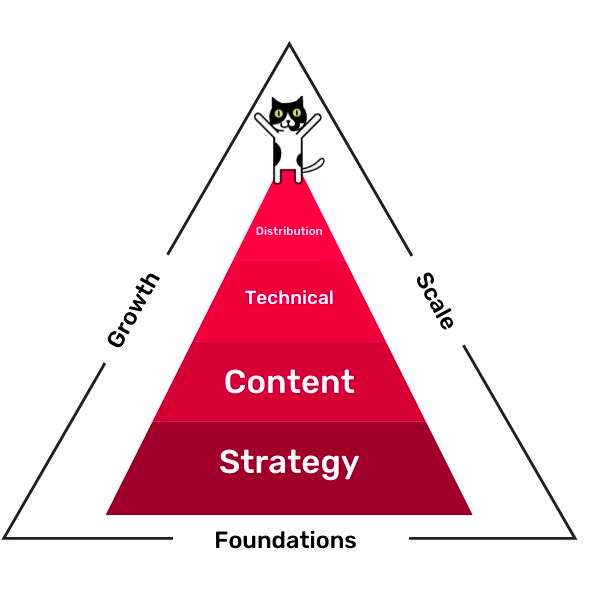
Enter Flying Cat’s Foundation, Growth, Scale (FGS) Framework.
It’s a proprietary process aimed at SaaS companies that optimises on-page, off-page and technical SEO, creates content that drives inbound search traffic, and then scales the operation.
With Operto, Flying Cat complemented their FGS framework by partnering with an ad company to create demand in the short-term, while waiting for the SEO channel to kick in.
Their complete inbound growth strategy leveraged four channels (SEO, content marketing, paid social, and PPC) in tandem to create and capture demand.
The result:
- 3x more inbound leads (demo requests)
- 400% growth in ARR
- Organic search became the #1 driver of inbound revenue, replacing the paid channels.
Read the strategy teardown below:
Foundation-Growth-Scale: FGS Framework
Let’s unpack the three-part FGS framework and see how they were applied to Operto.
1. Foundation
The first level of the FGS framework focuses on the foundations of a good website:
- The architecture of the website
- Internal linking
- Technical SEO
- The website's UX and conversion optimization
- Bottom of the funnel content (key landing pages and high-intent blog posts)
Following best practices in these areas is critical. Everything else builds upon them, so you don’t want to start with a rocky foundation.
Once Maeva developed a clear picture of what the main issues were with the website, the next step was to begin content creation.
But what content do you create first?
In the Foundations stage of FGS, you want to focus on bottom-of-funnel content:
- Commercial intent keywords
- Transactional keywords
- One page per feature plus use case
- Competitor comparison pages
- Bottom-of-the-funnel (BOFU) content
When asked how she decides what to create first, Maeva says it’s best to put it through a framework.
She starts by looking at each feature, service, and product then adds modifiers to create bottom-of-the-funnel content.
For example, take each of your features, products, and services:
- Feature
- Product
- Service
And add modifiers to find BOFU keywords:
- Feature + Use Case
- Feature + Industry
- Feature + Role
- Feature + Business type
She also uses tools like Ahrefs and Google Search Console to identify different seed keywords.
Although there are thousands of keywords and variations, Maeva notes that the most essential content to write first is what will generate revenue the fastest.
This means leaning into long-tail keywords.
When choosing what keywords to use, SEO best practices teach us to use keywords with the highest search volumes.
However, this isn’t necessarily going to get you more revenue. High-volume keywords tend to be top-of-funnel, i.e. much more distant from the value your product provides. They’re also extremely difficult and competitive to rank for.
It’s considerably easier to rank for long-tail keywords (5-8 word phrases) because fewer websites compete for high rankings in Google Search.
Often they’re also very problem-focused: the longer queries are usually “how do I do… x” which means you have an opportunity to create a useful guide or template.
2. Growth
The second level of the FGS framework focuses on:
- Creating SEO content around customer pain points—helping them on their education journey
- Developing middle-of-the-funnel content that persuades and converts
Before moving on, hear from Maeva as she explains why you need to write middle-of-funnel and problem-solving content in the Growth stage (and not just focus on BOFU).
Growing inbound demo requests
In line with their strategy, Flying Cat used search-optimized content and PPC to grow revenue at this stage for Operto.
Maeva had an interesting strategy where she started the SEO and PPC at the same time.
While waiting for the SEO to kick in, she worked with her partners to run PPC and social ads.
This resulted in:
- Half a million impressions per month
- Cost per conversion of $27
I asked her why she started PPC while waiting for the SEO to rank, Maeva said that SEO takes a while to kick in and you get data pretty fast through PPC. That way you can see what experiments (e.g. messaging & landing page design) are and are not working without waiting.
How long does it take to see SEO results usually?
Maeva quickly pointed out that it depends on how you define results.
Leads? Conversions? Sales?
For Operto, it took just five months before SEO started outperforming PPC.
The timeframe to reach a positive ROI depends on the Average Contract Value (ACV) of your business and usually takes more than a year.
From my experience, it’s important to invest in SEO because it will continue to grow your revenue.
Even though it takes some initial investment, it’s worth it in the long run.
If you invest only in ads, your money can burn up pretty quickly.
3. Scale
The third level of the FGS framework focuses on the following:
- Finding scalable opportunities
- Programmatic SEO
- Localization and translation
When finding ways to scale SEO, it's good to know that each company is different.
You have to analyze the product and the website.
Maeva recalls a past client who offered a website-building service. The service had both free and paid subscriptions.
If you had a free subscription, the website you built would have a badge with the website building service’s logo.
Flying Cat saw this as an opportunity to scale SEO.
They simply placed anchor text below the badge with some high-ranking keywords and their client’s traffic increased by 24% overnight.
This was a great and innovative way to build more traffic to the site.
Another way to scale SEO is by using Programmatic SEO to build a landing page or blog templates through Python, for example.
Flying Cat continues to work with Operto to drive even further growth.
The topic cluster model
Last week I deep-dived the topic cluster model in my talk with George Chasiotis.
Maeva applies the same model to her clients.
What is it?

The pillar/cluster model of SEO begins with a pillar page article that usually targets the parent keyword for a topic. This page is high volume, high level and top of the funnel.
Subtopics, or ‘cluster’ articles’, are then built around the pillar page with supporting information that the reader can access. Each of the cluster articles links to the pillar piece and vice versa.
The model benefits the reader (a more in-depth and easy to navigate learning experience) and your coverage of all the relevant topics and subtopics signals to Google your deep authority on the subject.
Why is it important?
There are a few reasons why this strategy works well.
Firstly, Google specifically looks for Expertise, Authoritativeness, and Trustworthiness (EAT) when ranking websites.
Alongside backlinks from authoritative websites, it’s important to create lots of content on the same topic to send an important EAT signal to Google.
When you do that, you show Google you likely have deep expertise on the topic. You have ‘topical authority’.
The better your EAT, the higher you rank. Deep dive into this subject in Semrush’s guide to building EAT.
Secondly, Google wants to offer its users a positive experience. For that reason, they assess metrics like bounce rate and time on page.
A well-designed topic cluster keeps the reader moving around, reading more and clicking from one blog post to the next.
Google will reward that extra engagement rate.
How do you create a topic cluster?
- Choose a few topics to be an expert in (those that align with your product value)
- In your keyword research define the parent keyword and all the subtopics that need to be included
- Keep creating content around those topics for months until each keyword is exhausted.
- Make sure to interlink articles to each other and to the parent pillar page
This is a surefire way to boost your EAT.
Four quick-fire questions on SEO techniques
Q1: If you had to choose three, what ranking factors are most important?
- Search intent (this is the most important)
- EAT
- Quality of content
Q2: Are backlinks important?
SEO is holistic. It needs all parts to function for it to work. So, yes, backlinks are important if they’re done well.
Q3: What is a good backlink?
The best way is to find another website that is relevant to you that publishes good content and gets traffic. Build a relationship with them and build up posts that help your brand. Provide useful content for your audience to backlink to.
Q4: What makes a piece of content high quality?
High-quality content is relevant to the person who reads it. It provides actual insight and doesn’t just regurgitate the top ten pages on Google. It needs to be from someone writing from their own experience. It’s essential that it’s easy to read.
Wrap Up
It was great having Maeva on the show. Seeing the growth of her team over the past 12 months is truly inspiring.
I hope you learned something useful from the nuggets of wisdom she shared with us this week.
If you’re interested to learn more ways to grow traffic, listen to my conversation with Dimitris Drakatos on how to grow traffic from 0 to 2.3M in just 12 months.