

In the latest How the F*ck episode, we heard from Adam Smith, Founder of Niche Site Builders.
He's grown (and sold) 100s of blogs in his time and has perfected the art of choosing niches that are:
- easy to win
- fast to win
- monetizable
The trick to this is to base your niche selection in deep competitor analysis. And that's actually quite simple to do, albeit time-consuming.
In this week's Premium SEO case study, I'll share his process for analyzing the competitive landscape.
Whether you're in SaaS or niche blogging, this should help you find uncompetitive areas of traffic to win.
Step One: Topic selection
The first step in this is choosing a broad topic.
My general advice on this has always been: choose an area you're passionate about.
A niche blog is often a slog, you need to do weekly blogging for a year before seeing results.
You're only gonna stick to it if you fall in love with the process.
But, if you're purely building a blog as an investment—one you can build & sell—then passion matters very little.
What matters instead is:
- Is this traffic I can actually win?
- Is this traffic I can actually win, at a cheap price point?
If your blog is an investment, it makes sense to invest capital into writers—which costs money.
But it costs considerably less money IF you choose an easy topic.
So, when it comes to topic selection, it's better to build a blog that can be created by non-expert writers with a knack for research:
- Food
- Spirituality
- Animals
- Travel
And not these:
- Finance
- Healthcare
- Law
- Strategy
Within the broader easier topics, we can choose even easier sub-niches.
Broad topic: Food
Subniche: Italian
Blog concept: "Best X recipes" [e.g. Best Mushroom Pasta Recipes]
A blog with specific niche relevancy around "Best X Recipes" in the Italian food space would be easier to scale.
We could now:
- build a template around the pattern (every blog post follows a simple-to-follow formula)
- simply round up all the best Italian food recipes, categorize them, and ask writers to whip them into a compelling listicle
That way we can scale up and win traffic faster. 👌👌👌
Related Read: How RetroDodo $50K Monthly Revenue in 3 Years
Step Two: SERP Competitor Research
Even those "easier-to-write" topics could be extremely competitive.
That'd make them a no-go for creating a build-and-flip niche blog.
So, this section is where things get interesting.
In the podcast episode, Adam Smith shared with us his process.
His team has 5-10 broader topic areas they'd go after. They've then created an ENORMOUS database of blogs on each of those topics—all found by scouring the internet.
They then filter those by low domain ranking, and high estimated traffic, to find sub-niches where low authority sites are getting an unusual amount of traffic.
We heard last week that if you're starting a brand new niche site, you can pick up an aged domain with DR 30 for around $3,000-$4,500.
So we're going to find SERP competitors with a DR <30 and copy their strategy.
Name of the game? Look for sites in your topic area with:
- Poor backlink profile
- High traffic
The proof is in the pudding: this is an easy-to-win niche.
To make this really clear, let me run a step-by-step for doing this.
Step 1: Topic selection
For the purposes of this guide, let's choose food. Subniche: Italian food.
Step 2: Look for low domain authority sites in that niche
Let's take a guess at Italian food and start chucking in keywords to Ahrefs.
We're going to dig around on the internet until we find a list of low domain authority sites in this niche.
My process?
If you're an Ahrefs user, go grab the Chrome Add On to speed this all up.
Then, Google "Italian food" and grab the top niche blog URL.
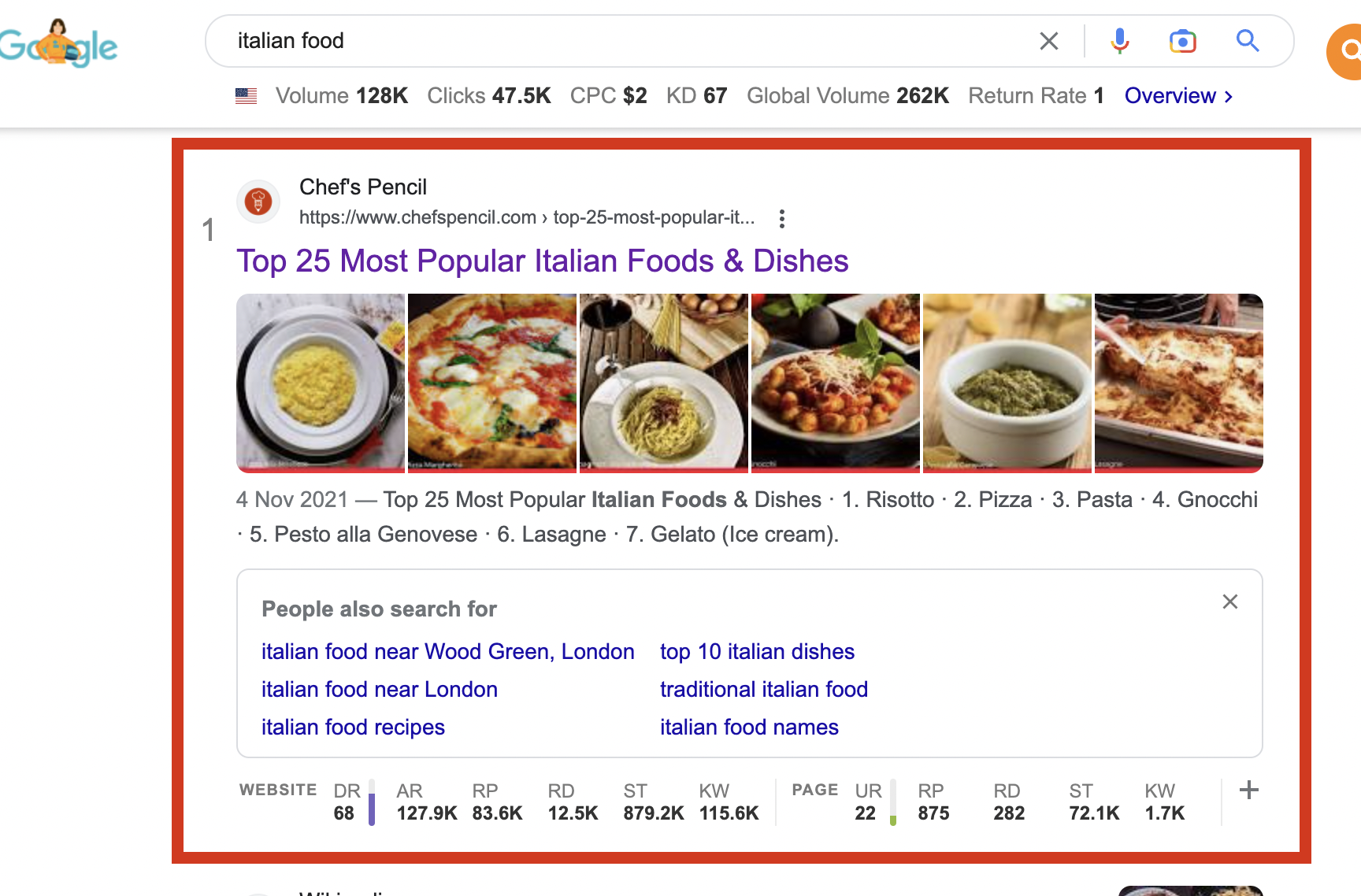
Put this into Ahrefs and look at the keyword report.
This should give us some ideas for keywords to go after:
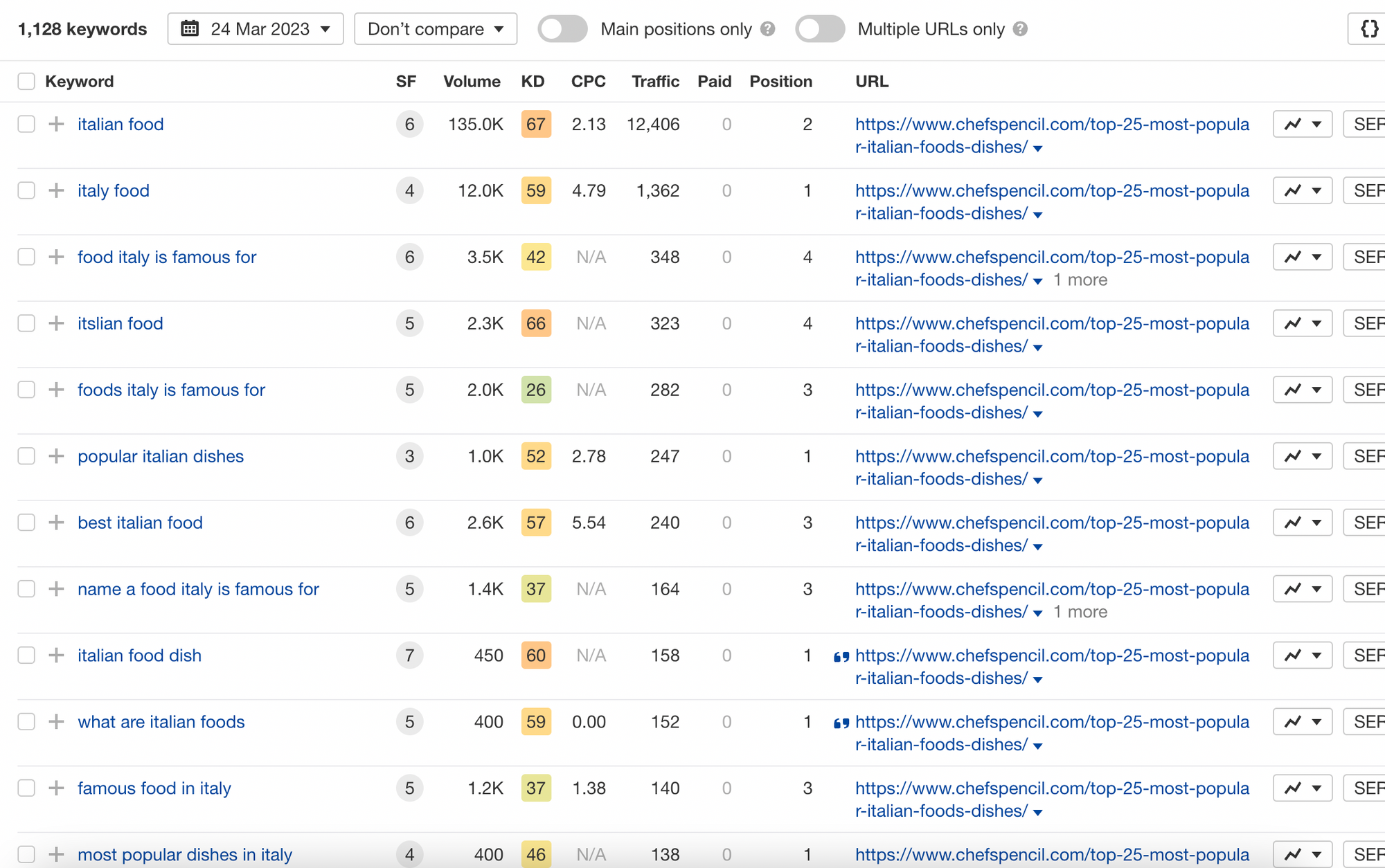
Dig around in this mass of keywords. For example, try adding a filter for Keyword Difficulty <10.
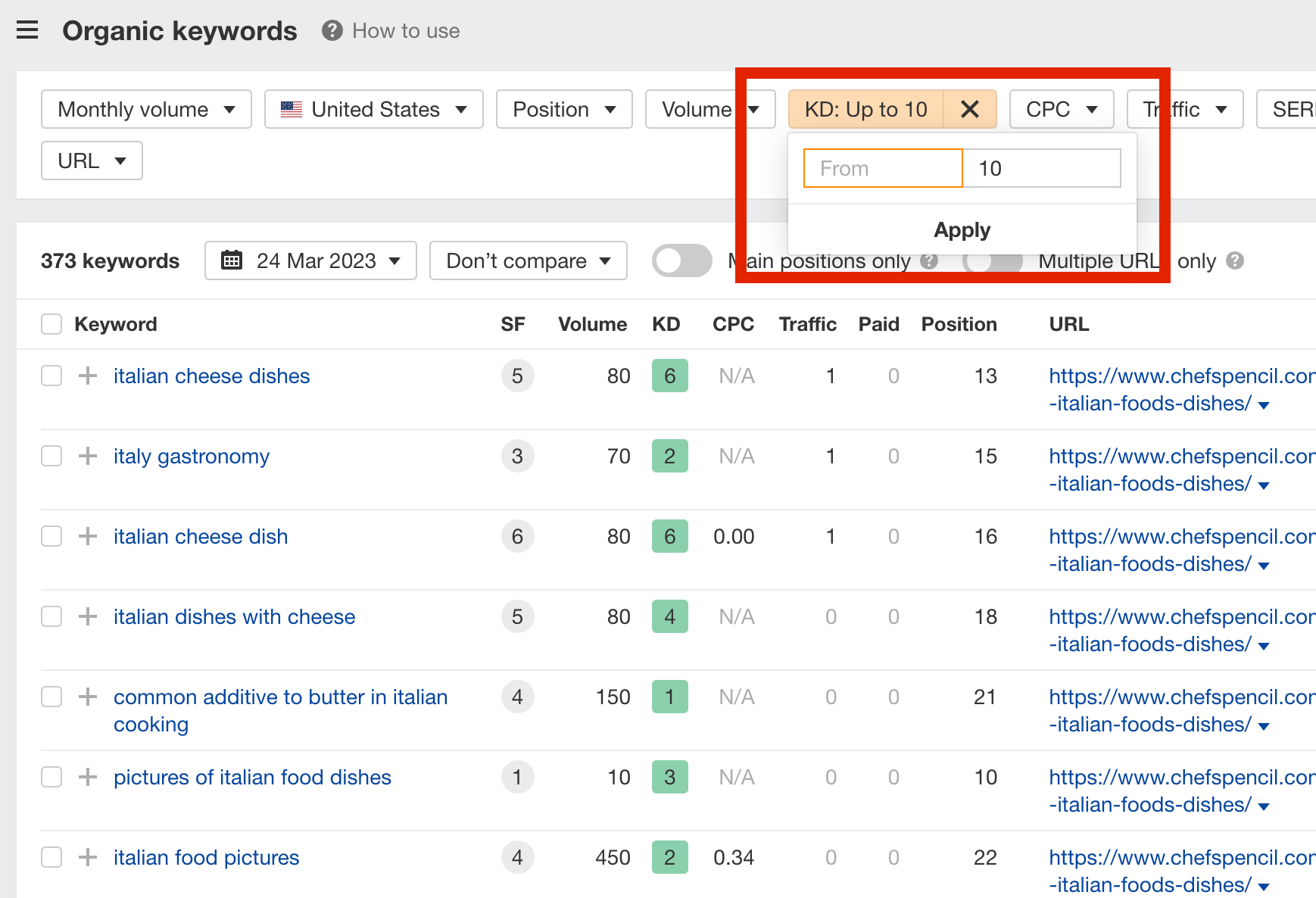
Now we have a list of "easier to win" stuff. This is gonna lead us to sites with low domain authority. Ahrefs KD is fairly meaningless but it's a good place to start.
Next, take one of these keywords and click on it. Head to the SERP overview to see what other sites are ranking for that keyword.
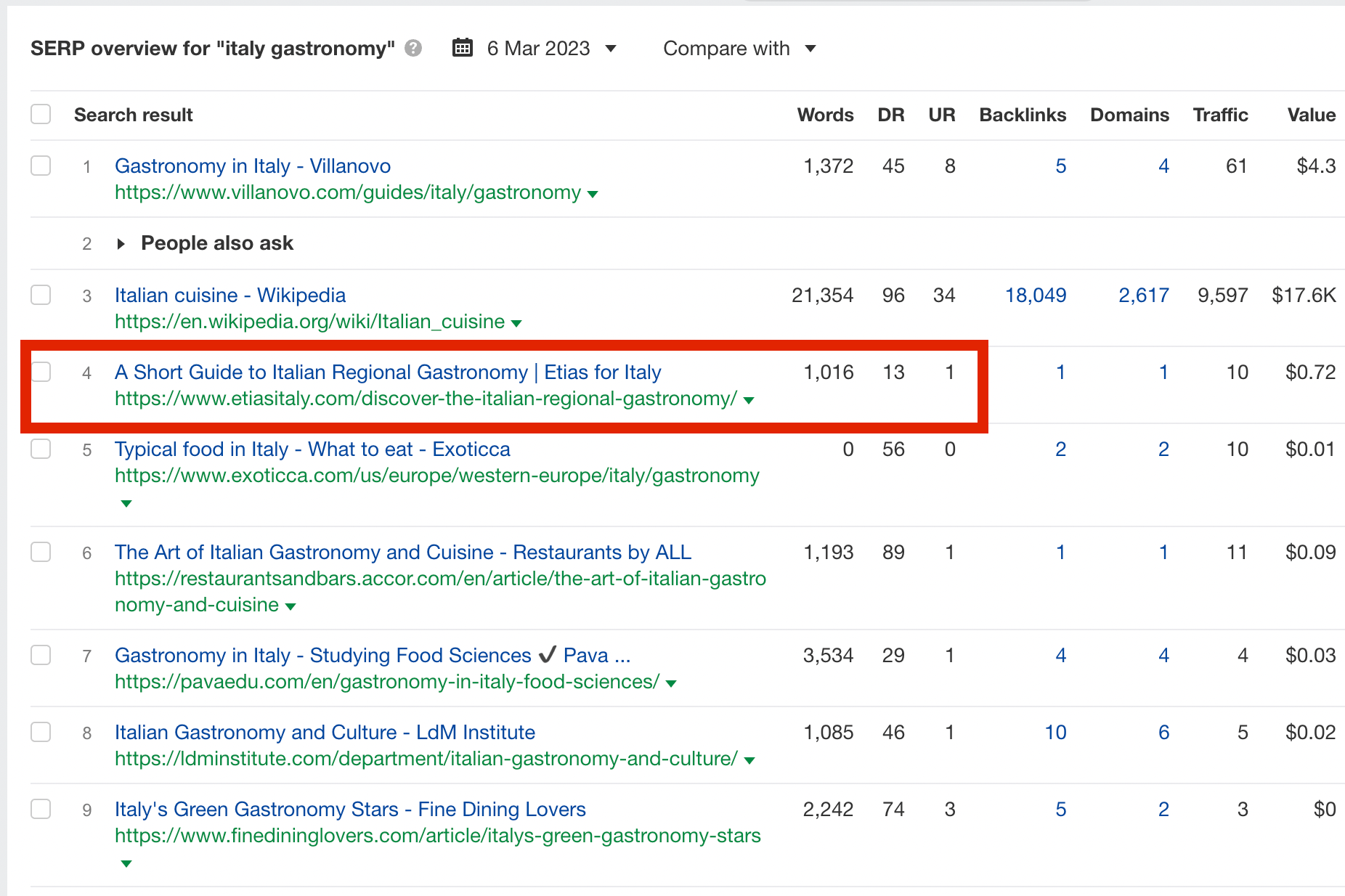
For this keyword, "Italian gastronomy", we can see that a DR 13 ranks in the top 3.
Cool. Save the website.
Repeat this process again and again.
We want to end with a really big list of low DR (<30) websites within the niche.
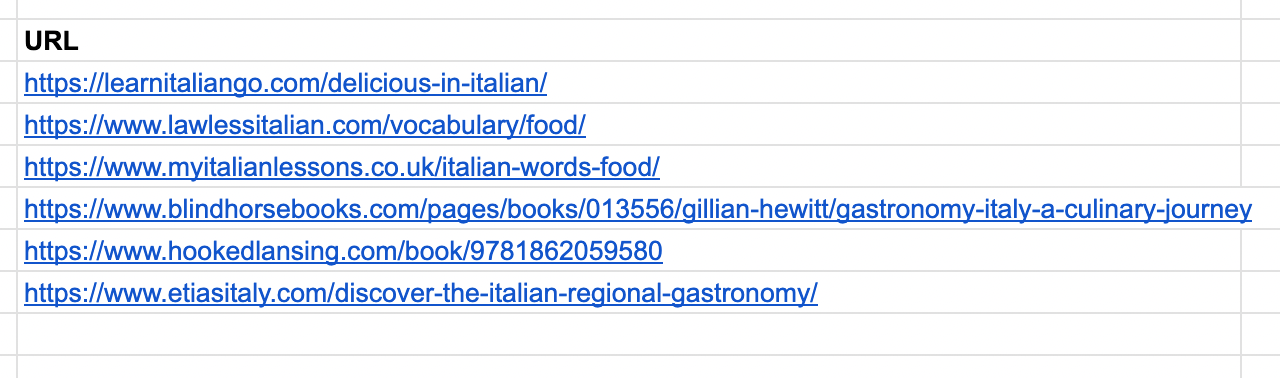
Above are 6 Italian food websites with <30 domain ratings I found in 2 minutes.
Step 3: Run a batch analysis
Re-upload these into Ahrefs batch analysis to append data:
- DR
- Traffic
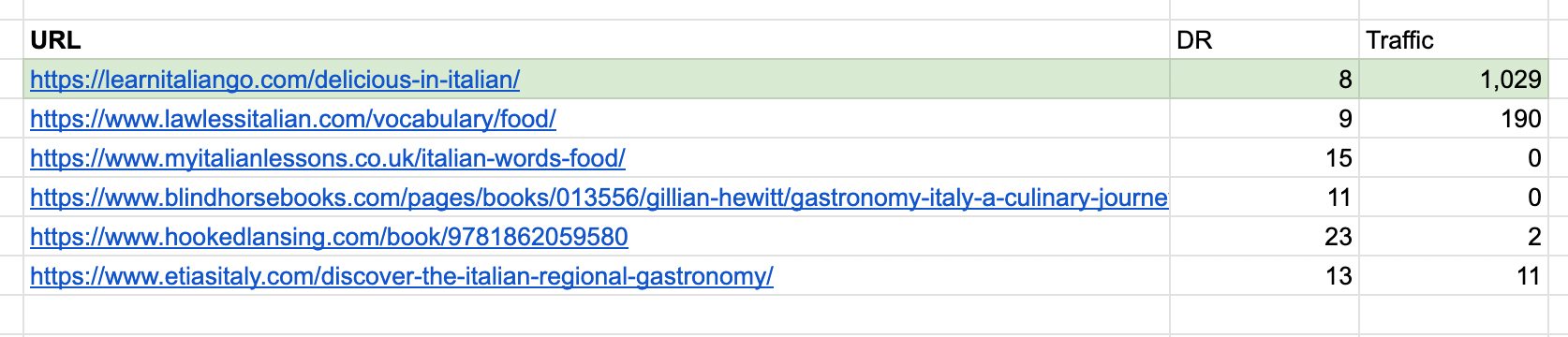
This is a great example because I've run into our first issue: it turns out none of these websites have much traffic.
As a reminder, we are looking for websites with:
- Poor backlink profile
- AND high traffic
So we will need to go deeper and deeper until we find them.
Do this and you'll find some hidden gems.
Here's one example I found:
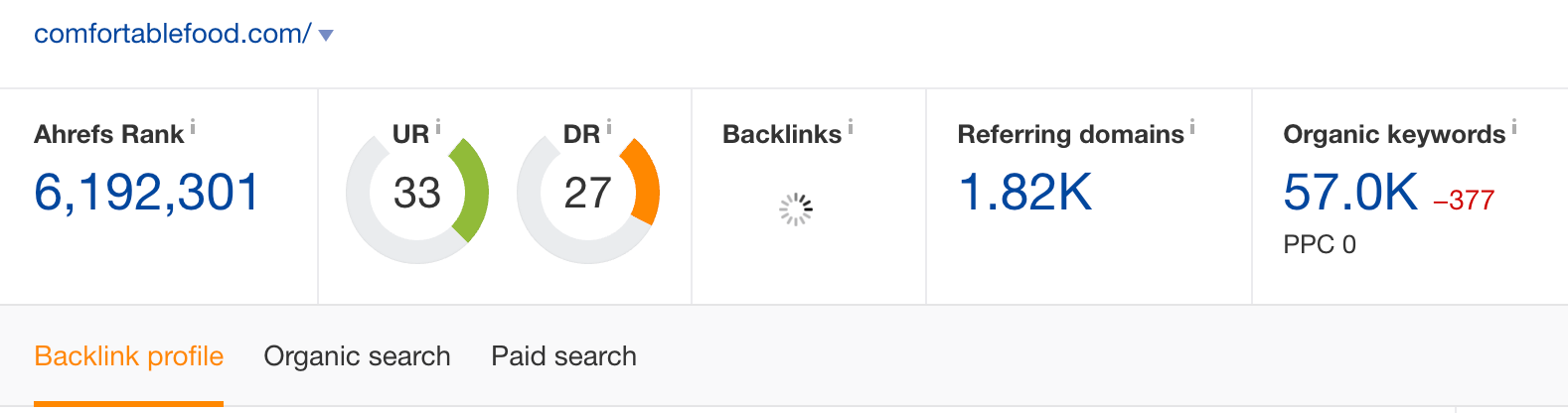
- DR 33
- Traffic 57,000
Here's another example:
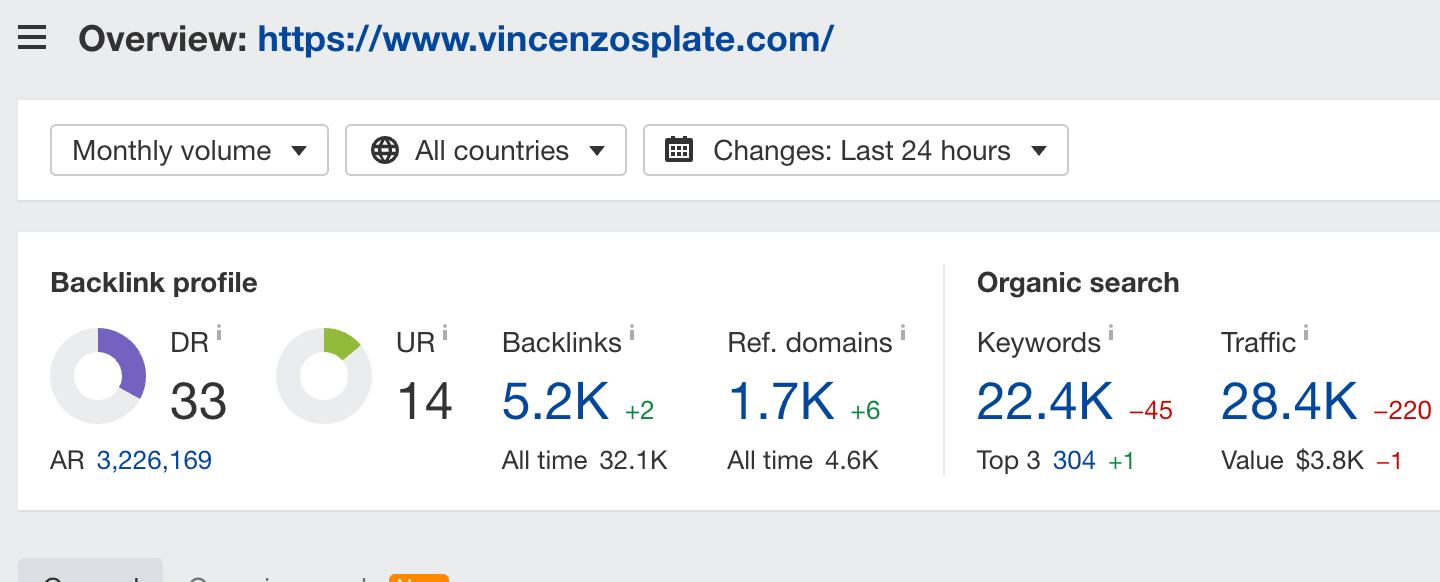
- DR 33
- Traffic 28,000
Both are a little over my 30 DR threshold, they're still solid traffic and fairly low authority.
Keep looking for more and more of these sites. Build yourself a low DR database.
But also, make sure to remove the crap:
1. avoid those with low traffic
2. avoid this with tons of traffic from an outlier blog post
"If it's one page or two or three pages, getting the majority of that traffic, we just removed it from the list. Really, it's an outlier, and the outlier is they're doing well with one or two pieces of content. So we're not really interested in that. Something else is going on there. But what we're looking for essentially are these outliers where they've got a good distribution of traffic across a number of pages across the whole site."—Adam Smith
Step 4: Filter for low DR
Sort your URL list from lowest to highest, and check for abnormal traffic volume.

For example, the DR 8 with 54,000 traffic is a really interesting place to start.
It's likely that THIS website has:
- Discovered an easy-to-win sub-niche, and we can copy it and do the same.
- Has done something else unique we can dig into
Step 5: Analyze competitor sites
Next week, in part 3 with Adam, we focus entirely on this step.
We'll look at how to analyze the traffic of each of these competitor sites to review:
- What topics they focus on
- The distribution of traffic across pages
- What content and sub-niches are driving the most traffic
- How many pages they have in total on a topic (an indicator of topical authority)
"Let's narrow [what these competitors are ranking for]. Oh, Italian food. Awesome. That's expansive. But are you talking about spaghetti? Are you talking about lasagna? Are you talking about pizza? Oh, it's actually pizza. This is where we can see that there are websites with really low domain authority that are doing very well from an organic traffic perspective, more they doing good, and that's should be an uncompetitive space for us to start our research in."—Adam Smith
From there, we can devise a plan of attack for our own niche site.
We might find that "pizza toppings" is a particularly easy-to-win and underserved niche. Our whole blog could grow to 100,000 traffic by focusing on that topic alone.
This process is what Adam calls his "tomb-raiding SEO" strategy. We'll deep dive into it next week! ✌️