
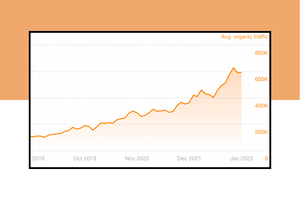
Hotjar's Senior SEO & Content strategist tells us how Hotjar leverages full-funnel topic clusters to drive success.
Hotjar's search volume increased 47% over the past 2 years.
That's millions of new visitors each year.
And the best thing?
Revenue results. It's driving *actual* revenue results.
Hotjar's SEO strategy is mission-critical customer acquisition.
And as a channel, the costs are proving to be significantly lower.
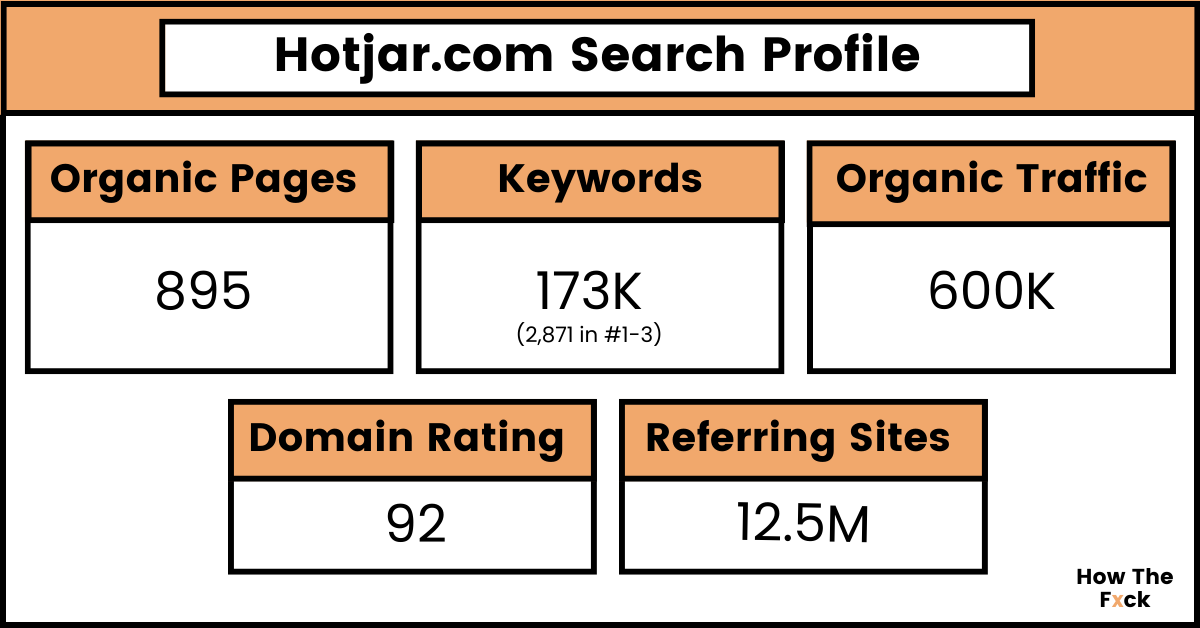
On the podcast this week, I've got Hotjar's SEO content mastermind, Sean Potter, to discuss how one of the most authoritative websites in the world approaches SEO-led growth
Every single one of Hotjar's 50-100 monthly new articles are consciously designed into full-funnel clusters that drive readers to the bottom of the funnel again and again.
In this week's SEO case study, we deep dive into exactly how they do this.
Expect to learn:
⚡Topic choice: How Hotjar leverages customers to unearth high-converting topics to write about.
⚡Topic clustering: How Hotjar builds topic clusters—it's not all about the keywords.
⚡Content experience: How Hotjar consciously designs content to drive readers to become customers.
⚡Backlink building: Does a website with DR 92 does backlink building
HotJar’s Full-Funnel SEO Strategy That Drove 47% Increase in Traffic in 2 Years
SEO has always played a key role in Hotjar’s customer acquisition strategy, and it’s an investment they’ve expanded significantly since Sean joined two years ago.
The team builds content in clusters on topics that are carefully selected using deep qualitative & quantitative customer research.
They plan their content to match the full buyer journey and leverage thoroughly tested custom-designed templates to drive readers down the funnel.
The attention to detail at Hotjar is unparalleled. They know exactly what content formats their customers love, how to authentically integrate Jobs-to-be-Done into content, and, importantly, which topics drive value across the customer lifecycle.
In this case study, we learn exactly how the Hotjar team has built an SEO machine that consistently drives paying customers (and a 47% increase in traffic in the past 2 years).
“We are far from exhausting the potential we can grow from SEO. It will remain a key part. It’s a channel we see a really good customer acquisition cost as well. The logic is there to backup continuing to invest in this.”—Sean Potter, Senior Content Strategist at Hotjar
Inputs:
- Volume: 50-100 published per month
- Team: 8 in-house, supported by freelancers
- Backlinks: Built strategically on content that converts
Organic Search Results (Jan- Nov 2022 vs same period 2021):
- 47% increase in organic search traffic in two years
- 20% increase in product sign ups
- 84% increase in sign-ups coming from topic cluster guides
- For the Website Tracking cluster: signups increased by 112% and new customers increase by 66%
“This is like…it's working. It's not just, okay, we're creating clusters that get traffic, but it's actually translating into what we're trying to do here with content as well.”—Sean Potter, Senior Content Strategist at Hotjar
We’ll cover four sections in this case study:
- Topic selection
- Topic clustering
- Content experience design
- Backlink building
Let's dig in 👇
How Hotjar chooses which topics to write about
“Keyword tracking tools are part of the puzzle, but I think too many SEOs rely way too heavily on them. The wider picture of topic selection is so much bigger.”—Sean Potter, Senior Content Strategist at Hotjar

Sean attributes Hotjar's success in SEO to the depth of their customer research.
So often, content teams will review keyword search volume and assume that, when the volume is right, their customers must be interested in those topics.
In reality, this is just not true.
When you talk to your real customers, they’ll tell you quickly that a topic isn’t interesting, it’s in the wrong format, and it isn’t part of the buyer journey for your product.
Your assumptions often get proven completely wrong.
“It stops the “I'm gonna create x content piece because I can see it has good search volume”, but actually like when you speak to a customer [they say] “I've got no interest in this, why have you created this piece of content?”, that's just one example.”—Sean Potter, Senior Content Strategist at Hotjar
Here are the customer research techniques Hotjar prioritizes:
- Quarterly customer interviews
The goal: Challenge assumptions
- Surveys of existing customers
The goal: Find out if the content helped or made them use Hotjar, and if customers find the site overall a helpful resource.
- Talk to the product team for insights
The goal: Reverse engineer insights from the product flow. What are the barriers people are facing when signing up?
What Jobs-to-be-Done are they trying to solve?
The content team can either weave them into the narrative, using real examples in the content, or use them to fuel new keyword ideas.
- Historical content performance data
The goal: Leverage their vast bank of historical performance data to decide what content to do more (and less) often.
They ask their data:
- What's driving signups in the past?
- What’s driving LTV and CACs?
- What’s driven most paid subscriptions?
- What content could be performing much better?
This data can be used to hone in on the content that drives the most positive outcomes for Hotjar moving forward.
How Hotjar Design’s Full-Funnel Topic Clusters
For the purposes of this case study, let’s hone in on one of Hotjar’s topic clusters: The Website Tracking cluster.

In the past year, this cluster increased monthly organic visitors by 150%. Leading to a 130% increase in free organic signups and a 70% increase in paying customers. All thanks to Sean’s approach to SEO and content.
While this cluster in isolation isn’t creating headline growth, it’s important to remember that they have 10s and 10s of clusters like these (and a repeatable process for creating them.)
“[The Website Tracking cluster] is a really good example of when you do the basics really well in SEO, you can drive really strong growth.”—Sean Potter, Senior Content Strategist at Hotjar
Example #1: The Website Tracking Cluster
Step one: customer research
The first stage in topic cluster design is leveraging prior customer research to choose a topic that will resonate with the reader.
The team at Hotjar knows “website tracking” is one of their core use cases and a big part of why customers love the product.
Step two: keyword research.
To determine which topics have search volume, traditionally, you’d now head over to a keyword research tool like Semrush and research the term.
You might emerge with a list of semantically related keywords to tackle:
- Website tracking: 10,000 monthly traffic
- Benefits of user tracking: 900 monthly traffic
- Website tracking tool: 4,500 monthly traffic
- Website eye tracking heatmap: 200 traffic
Hotjar's approach is a little different to this traditional clustering.
In this example, the Website Tracking cluster has these 5 articles:
- Website tracking guide
- How to track user activity on your website
- 17 best website tracking tools to measure traffic
- How to compare website traffic and benchmark against your competitors
- Privacy-first website tracking

They aren’t all variations of “website tracking”. Instead, they’re all topics important to the reader learning about this topic.
Some topics still hit on a keyword, for example, “website traffic comparisons” has monthly search volume behind it.
Others, like their article on Privacy-first website tracking, appear to have zero direct organic traffic going to them.
Covering the full funnel with a topic cluster
Sean notes that his team aims to cover the full funnel journey as best as possible with each cluster.
That means including “What is X?” through to “Tools for X” and everything in between.
Top of funnel:
People who want to discover more about a topic. [Content: What is Website Tracking?]
Middle of funnel:
People evaluating how to get better at doing it in their job [Content: Website Tracking Comparisons & Benchmarks]
Bottom of funnel:
People who realize they need a tool (or to change tools) to do the job more effectively [Content title: Best website tracking tools]
This ensures the reader is fully served and has a “what next?” to their research. The absolutely worse thing to happen is your content pushes the reader down the funnel, but they have to return to Google to get their next questions answered. That’s where you lose the opportunity to capture a reader.
Another benefit of this method? Topical authority.
“Hotjar has a really, a really like strong topical authority in a lot of different niches and so that definitely, that definitely helps us and probably gives us, or definitely gives us an advantage over a site that might be trying to do this with far or less authority.”—Sean Potter, Senior Content Strategist at Hotjar
Topical authority is achieved when a site fully covers a topic as a whole rather than focusing on just individual keywords.
Example #2: The Net Promoter Cluster
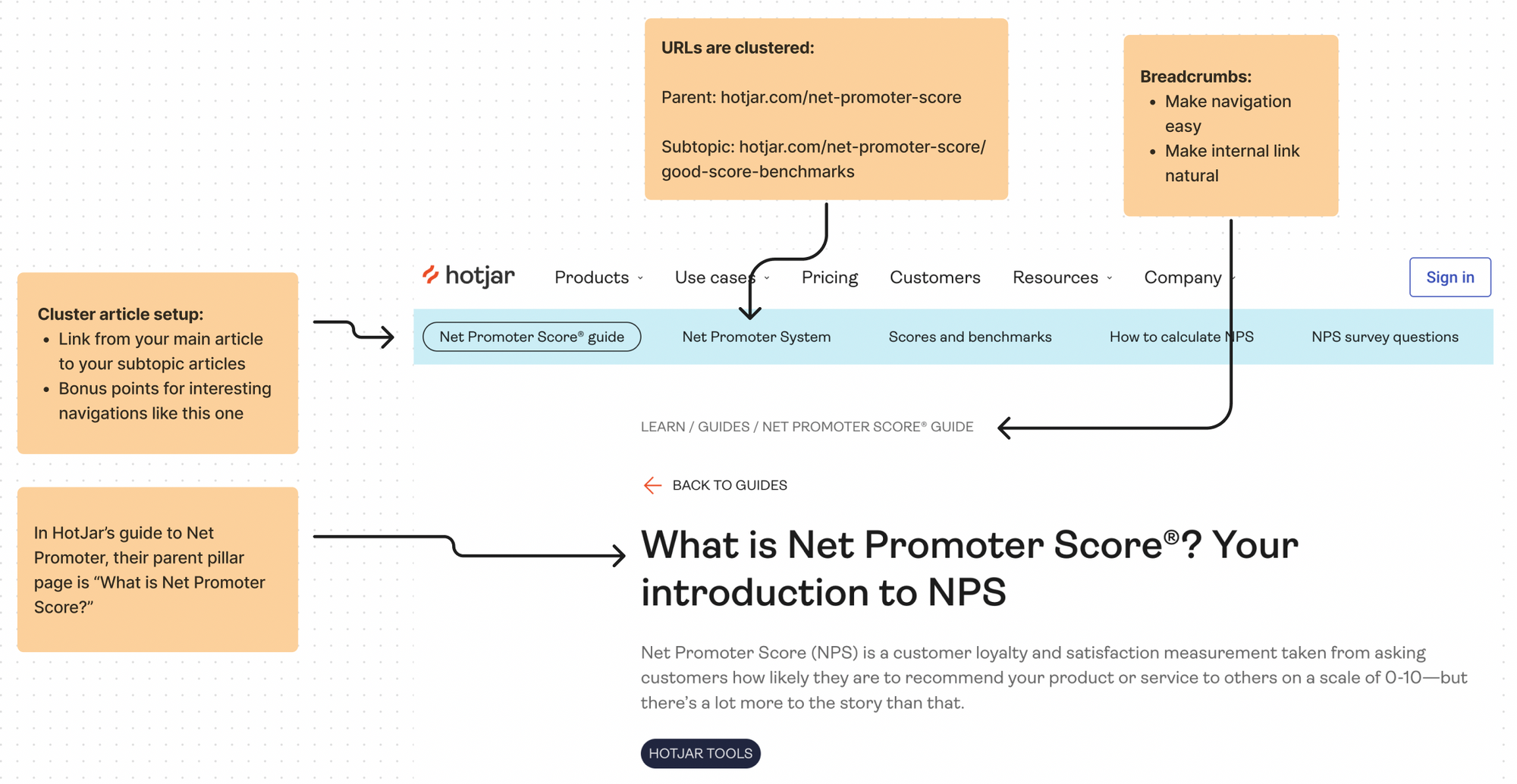
HotJar’s Net Promoter cluster is more traditional in that it covers the full range of semantically related keywords.

Articles include:
- What is Net Promoter?
- Net Promoter Sytem
- NPS Benchmarks
- How to Calculate NPS
- NPS Questions
- Setting up an NPS Survey
- NPS Analysis
- Improve NPS
And they have their NPS Software landing page interlinked throughout (which ranks in the top 5—incredible considering Hotjar has not traditionally been an NPS survey collection tool.)
This cluster overall is much more education-focused. Net Promoter is a complex topic and there's lots to get to grips with. However, the content maps nicely to the jobs to be done of Hotjar's survey collection product.
How Hotjar Designs a Winning Content Experience
Hotjar's, UX and UI design actively drive reader engagement and conversion.
There are three things of note here:
1/ The content user interface (aka blog template)
Hotjar’s guides leverage a customer navigation template that’s designed to drive the reader down the funnel and keep engaging with the content.
This is a big part of their secret sauce. It's engaging, it keeps you reading, and it actively pushes you to their tools.

“We don't want someone to learn about website tracking and then disappear. We want them to want to learn more. The navigation funnels them towards the next step of their journey and level of knowledge. So, yes, it’s a conscious decision.”—Sean Potter, Senior Content Strategist at Hotjar
2/ Variable content formats
“We ran a survey of our audience and said it was as simple as like, “what format do you want to digest your content in?” And so that played a big part. We know that people wanna digest way more video.”—Sean Potter, Senior Content Strategist at Hotjar
In the last year, Hotjar created more than 50 pieces of video content. In 2023, they plan to 3x that.

Hotjar also includes things like audio versions of their content.
Sean noted that they see evidence of an uplift in performance when these additional format types are present.
3/ Authentic product mentions
“It has to be the case that when we mention Hotjar, it is authentic.”—Sean Potter, Senior Content Strategist at Hotjar
Hotjar includes lots of examples of how to use their product within their content. And it works well for them.

“Let's use the website tracking cluster. It's like, okay, we can mention Hotjar, but if we're gonna do it, let's make sure that we're deeply empathizing with our customer needs when we do, because otherwise it's just forced. And that's not something that really is a good fit for our audience.”—Sean Potter, Senior Content Strategist at Hotjar
These three things make sure the content has a balance between the company's interests and deep concern for the reader.
How Hotjar approaches link building
Hotjar does link build actively. They focus on securing link placements on hyper-relevant industry websites for specific pieces of content.
They do so for specific purposes rather than a spray-and-pray approach. For example, if they know a piece of content has high conversion metrics and delivers customers with a strong lifetime value, they might choose to try and push it up the rankings.
“We rank in position 3 for a piece of content that’s high converting and top performing, how can we use links to get it to position 1?”—Sean Potter, Senior Content Strategist at Hotjar
Where do they target links from?
Usually, as niche as possible a website for that niche. Websites that are experts in their area and, therefore, have huge topical authority.
I asked Sean, how many links are needed to move up the rankings. He said:
“I think you can push yourself up the rankings a couple of positions with less than 10 links. Like I don't think it has to be vast amounts. Like sometimes it might be like three or four. Like really targeted placements in the right spaces I think can drive the growth. It isn't always an exact science.”—Sean Potter, Senior Content Strategist at Hotjar
What are some common mistakes Sean sees in the SEO world?
- Overreliance on keywords and keyword-driven content. It’s part of the picture but people are missing the point of talking to customers and factoring in qualitative insights.
- An over-focus on vanity metrics. He wishes more people talked about revenue outcomes. The end goal of growth is everything in SEO.