
Jake joined Typeform in June 2015 as employee #29.
In his first couple of weeks, they celebrated hitting $1M in annual revenue from 5,000 customers.
By the time he left just 3.5 years later?
Typeform had:
- 10x the employees
- Grown to $13M in ARR
- Grown their SEO channel to $3M in yearly lifetime value revenue
In this week's SEO case study, we hear how a growth marketer scales SEO with:
- Product-led SEO techniques
- Retention-driven topic choices
- Growth modeling for search
- Processes designed to win
It's a good'n peeps.
Expect to learn:
⚡How Typeform selected and prioritized keywords to drive the most revenue growth (an example of product-led SEO in action)
⚡How Typeform built out their template library, ranking for 1,000s of bottom-of-funnel keywords.
⚡Typeforms unique backlink building technique that scaled them to 2.3M backlinks (and 93 domain rating)
⚡How to build an SEO growth model that makes sure your strategy prioritizes revenue (with template)
Listen here. Or find all our SEO podcast episodes here.
Typeform’s SEO Strategy: Building a $3M Annual Lifetime Revenue Channel
Typeform’s product was innovative.
They invented the one-question-at-a-time approach to surveying, and it quickly took off.
When Jake joined Typeform back in 2015, he was a performance marketer and Typeform had yet to implement SEO. His budget in his first month was €5K to make something happen.
Just 3.5 years later, he’d built Typeform’s SEO into a $3M a year channel and executed one of the most successful examples of product-led SEO I’ve ever seen.
His monthly budget? £500K.
“Traffic? I have no recollection, to be honest. We weren’t looking at traffic at all. We were super obsessed with sign-ups and customers. Some keywords drove more sign-ups, others more customers.”—Jake Stainer, Ex-Typeform Head of Growth, Founder @ Skale
Results:
- 30,000 non-branded organic signups (all signups from non-feature, pricing, and product pages)
- $3M a year in LTV (new customers x lifetime value)
- 50,000 paying customers
Let's dive in 👇
How Typeform Does Site Architecture
When Jake first joined Typeform, the first SEO case he made was to add a “footer” to the website.
He’d discovered several orphaned product landing pages (they have no internal links to them) and adding them to a footer would solve the problem.
“There’s a bunch of landing pages without internal links just floating in space and everyone was saying “Hey, why don’t they rank?”—Jake Stainer, Ex-Typeform Head of Growth, Founder @ Skale
Typeform had been building landing pages with product-based templates on them for paid campaigns. Adding them to the footer was a simple way to let Google find them and start bringing in traffic to them.
Let’s take a deeper look at Typeform’s website architecture:

A few things are of note to us in the SEO world.
1. Typeform’s core landing pages target the highest-intent keywords
Those are:
- Quiz maker
- Form building
- Survey maker
- Test maker
- Poll maker
They keep these on the closest URL structure to the root domain to show their importance. For example, the quiz maker page is on typeform.com/quizzes.
Survey maker is highly competitive, to help win it, they developed a cluster of content within the subdirectory to build topical authority and backlinks on that topic. For example, examine the URL structure for this blog post on survey questions.
(We’ll dig into topic clustering a little later).
2. Templates are Typeform’s largest growth driver
In this case study, we’ll focus on Typeform’s template library.
Typeform’s product has 1,000s of use cases—every reason one might want to create a survey, for example. Their product helps the user collect information and is perfect for surveys, forms, tests, and polls.
This puts them in a very fortunate position when it comes to SEO.
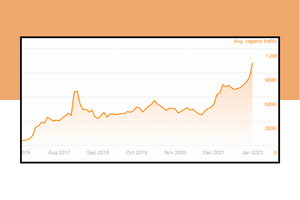
Ahrefs shows that Typeform’s template library subdirectory by far accounts for their highest volume of traffic. Jake confirmed that almost their entire SEO strategy was template related.
So, what was the strategy? Why was it so successful?
How Typeform Leverages Templates to Drive Revenue (And How You Can Do the Same)
Typeform was doing product-led growth before they knew what it was. Before the industry was talking about it, even.
Their template library is a classic example.

Each template:
- Uses the product to deliver value
- Has it’s own CRO landing page
- Targets a specific keyword
Here’s one example:
- Online registration form template
Top keyword: “registration form online” which has 8,000+ monthly searches
Current position: #1

As you can imagine, any visitor to this page is highly likely to sign up to the product. Especially since it’s free to do so. The time to value from search –> fulfilled intent is extremely short.
There are more than 1,000 templates like this in Typeform’s library.
“I guess the trick is how can you relate your SEO to your product as closely as possible and not start creating like just educational content. “How can you sort product to inform your SEO strategy”—Jake Stainer, Co-Founder of Skale, Ex-Typeform Head of Growth
1/ How Typeform Prioritizes Keywords
There are 10s of thousands of potential template-related keywords Typeform could choose from, and their capacity was to create about 5-6 a month.
So, how did they prioritize which one’s to go after?
Step one:
- List all product use cases (and potential ones)
- Look at historical data from Google Ads to understand potential keywords
- Conduct a full keyword research, bringing all potential options into one place
Jake and the Typeform team then built a multi-factor prioritization/scoring model that would help them make revenue-focused decisions.
Elements in the scoring model
- Traffic potential
- Difficulty (backlinks needed)
- Conversion rate estimate (based on paid tests and historical data)
- Retention (the use cases customer success said were more sticky)
Their goal?
1. Prioritize templates that helped both acquisition and retention goals.
2. Prioritize templates that would see an ROI (e.g. if they were extremely difficult to win, and had low traffic potential, the investment wouldn’t pay back).
Jake noted in the interview that at that time, the notion of topic clustering and topical authority were not known.
If he could go back in time, he’d have built content in topic stacks: entire clusters of content around a particular topic, rather than simply selecting bottom-of-funnel keywords.
He notes that they were thinking keyword-level when they should’ve been thinking topic-level. A couple of their template keywords never ranked, and that was because they didn’t have as much topical authority as competitors on those subjects.
“You can't do keyword research and organize your spreadsheet in terms of high volume, low difficulty keywords. You have to do that, but with topics, and then create a pivot table and see the topics and then pick the topic not the keyword.”—Jake Stainer, Co-Founder of Skale, Ex-Typeform Head of Growth
2/ How Typeform Made Sure They Won High Intent Keywords
Typeform has a 93 domain rating (volume of backlinks) and currently sits in the top 200 websites of all time from a DR perspective.
This was by design.
Typeform’s link-building growth hook (2.3M backlinks)

Jake worked with the product team to embed a backlink within the code of their product. It was core to the product for customers to embed their forms in the website, each time providing a backlink.
Initially, every backlink sat over the anchor text “powered by Typeform” and sent the user to the homepage.
![How Typeform got over 100M backlinks [Image Source]](https://seo.thefxck.com/content/images/2023/01/image.png)
Jake eventually made the case that, given there were over 100,000 backlinks to the homepage, they could evolve this strategy.
They added logic to the embed, which made backlinks use case-related. Now, when the survey was being used for surveys, it anchor text would read “survey maker by Typeform” and the backlink would go to the corresponding landing page.
Some use cases were not embeddable. For example, Net Promoter surveys are rarely embedded on a website. For those, the Typeform growth team focused on guest posting and other backlink techniques to build authority.
Typeform’s first topic cluster
Typeform did build educational content, too.
They build out top-of-funnel content in clusters, especially around the survey maker use case.
Content like:
- Guide to survey analysis
- Types of survey questions
- How to conduct a survey
Jake noted that it took ages to rank this kind of content. And, I asked, was it worth the time?
He said, ultimately, yes it did bring customers. However, they had such an endless list of bottom-of-funnel keywords (the templates) that they could focus less on educational content.
This worked especially well for Typeform because of their high domain authority and ability to build backlinks at scale. Unlike you and me, they had the luxury of targeting bottom-of-funnel keywords without first building topical authority at the top of the funnel.
“Typeform is so broad and horizontal that there were so many templates we could make. We were so busy just making templates and ranking for those keywords, which we knew were gonna bring in people with an intent to use the product, that we almost didn't have time to even focus on the top-of-the-funnel keywords at all.”—Jake Stainer, Co-Founder of Skale, Ex-Typeform Head of Growth
How Typeform Does Internal Linking
Internal linking helped Typeform shift the keyword "Form Builder" from not ranking to where it is today (2).
"Form Builder" has a search traffic potential of 175,000 visitors per month.
And it's high intent for what Typeform does. They even verified its value with paid search first.
So, ranking in position 2 is an incredible growth win.
Their approach:
1. Choose your highest-value pages
Some pages contain keywords that:
- Bring lots of traffic
- Are proven to convert
Traffic x conversion = customer growth.
List these pages and prioritize them. It's important to add more internal links for the pages you value most.
2. Add links to your navigation
Typeform noted that being present in the footer/menu alone had zero impact on ranking.
It was until point 3 that "form builder" began to rank.
However, including them there:
- Passes on PageRank authority from your homepage
- Ensures Google regularly crawls those pages
3. Add links within blog post text
Contextual links are what moved the needle for Typeform.
They:
- Went through all their pages
- Found relevant anchor text "form builder"
- Place links there
The growth team even bribed customer success for access to their Help Centre WordPress so they could add links there.
Jake's top tip: Make sure you add anchor text variations.
Your anchor text should not ALWAYS be "form builder". Vary it slightly, make it more real so Google doesn't learn to ignore it.
4. Build it into your launch process
You don't want to keep going back through your library and adding links.
Instead:
- Launch a new page/post
- Add 10 internal links immediately
This will help rank your content significantly faster.
Idea: Make link-building fun
Internal linking proved so effective for Typeform that they organized link parties:
- Every Tuesday morning
- Whole team
- Go crazy on internal linking
“One time we brought some tacos into the office and just had fun. Internal linking is boring, but it works.”—Jake Stainer, Co-Founder of Skale, Ex-Typeform Head of Growth
3/ How to Build a Growth Model for SaaS
Jake suggests that to turn SEO into a customer acquisition channel you should build a growth model.
The growth model will allow you to prioritize content tasks that will drive the most revenue growth.
Here’s a simple step-by-step guide recommended for choosing which content to update by Jake here:
- Map out all existing pages with an SEO value. Identify the head term for each page. Ensure pages aren’t cannibalizing each other.
- Add on your keyword research ensuring each keyword is a page (this is a page-level model). Keyword research can come in many flavors such as customer interviews, PPC data, spending hours going through your sales CRM, etc.
- Augment this with the following data:
- Clicks past 30 days
- Traffic potential
- Delta between a and b
- Topic cluster
- Current RDs
- RDs needed
- Intent (low-mid-high)
- Signup->Paying CVR %
- Include the following calculations:
- Click uplift estimate if got full traffic potential
- Visit -> Signup CVR (based on intent)
- Signups
- Customers
- RDs Needed
“Now you have the growth model built, you can find where the growth opportunities lie by selecting which topic is the easiest to rank, has the biggest upside, and is most closely related to your product (ensure high signup and signup->customer conversion rates).”—Jake Stainer, Co-Founder of Skale, Ex-Typeform Head of Growth
4/ Three elements core to Typeform’s success
Our weekly question. And Jake’s answers:
- Focus on revenue, not traffic. Otherwise, you’ll get lost doing many things you don’t need to do.
- Link SEO to your product closely. Work out the logic behind the reader and the conversion: Is it a feature? Templates?
- Learn to make really great business cases. You’ll achieve much more if you can convince people to back your ideas and give resources.