
I interviewed Ryan Darani several months ago, just after he shared this fantastic graph on LinkedIn.
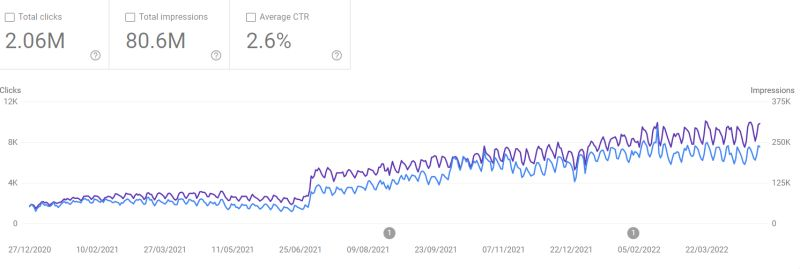
He'd been consulting for 16 months to help an at-home blood testing eCommerce company on their SEO.
Healthcare falls under the Your Money or Your Life (YMYL) category. The content in this space must be truthful, accurate and non-deceptive or it could directly influence the reader's happiness, health, or financial stability.
For obvious reasons, this content is particularly difficult to rank. It must be packed with Expertise Authority Trust (E-A-T) to pass Google's strictly guarded quality evaluations.
Despite these limitations, Ryan helped their content team scale traffic dramatically, from 30,000 monthly visitors to 195,000 🎉.
Regardless of whether or not you're in a difficult-to-win niche, this is a guide for winning no matter the circumstances.
In my interview with Ryan, we looked into the details behind this phenomenal success story.
We covered these key points:
⚡ We learned why links are a major part of the success of your site. But, you shouldn't start with them.
⚡ We learned why regular content expansion helped Ryan accelerate traffic growth (and 3 ways to do it).
⚡ We learned why you need to make your content unique (not a rewrite of the top 10 SERPs). Especially if your site isn't a huge authority.
⚡ We learned why improvement in 3 particular trust signals is where "real growth" came from.
⚡ We learned where Ryan sources expertise from, and how you can find unique, expert sources to tap into.
⚡ We learned about topical authority, and the key signals that tell you you've achieved it.
Listen above, or read below
If you're a Premium How the F*ck member already, find this week's organic strategy case study below. 👋
How to grow from 0 to 2m clicks in 16 months (with Ryan Darani, SEO Consultant)
Hey there! If you can see this, you're a premium subscriber (aka the GOAT 🐐).
This week's playbook is in interview-style. Ryan dropped so many knowledge bombs that I didn't want to leave much out 😵💫.
As a disclaimer, unless it's in quote marks it's not a quote. I've touched up sentences and added in clarifications along the way to make the interview a more enjoyable read.
Have a lovely week,
Ben 🐐
Case Background
Product: At-home blood testing. Sales funnel is traditional eCommerce, where tests can be purchased online. We didn't discuss the brand's name at all, but he mentions in the episode that you do a health quiz before purchase, so I imagine it's a company like Thriva.
Timeframe: 16 months.
Content volume: Started at 60 and grew to 200 blog posts.
Quality tip: Ryan noted that without the team of editors and writers who were 100% committed to creating the best content on the market, this wouldn’t have seen the growth that it does.
The key questions👇
How much content was there when you took over the project?
There were around 60 pieces of content on the website, and now there are around 200 blog posts.
We doubled the content, but the real growth came from retrospectively going back to all of the content that we had produced, looking through all of the signals that the page had:
- Who wrote it?
- Has it been medically reviewed?
- What kind of citations are we referencing?
- Where are the internal links going?
We did a really big sweep across the board and mapped out internal clusters more neatly.
For example, a particular condition such as diabetes could have hundreds and hundreds of articles on the topic. We set ourselves up where the clusters of that content only ever got deeper and they all linked back to the product pages.
While getting new content out was a big focus, we also really wanted to maximize how Google viewed each individual segment of content on the site.
What else is important when it comes to content optimization for E-A-T?
If a piece of content sits there for three or four months, you will get an idea of where it has plateaued. You’re unlikely to get any more growth out of this piece until we refresh it or send links to it.
Ryan looks at it as content expansion, so he asks “is there anything in the top 10 search results that don’t exist on my page?” That’s the first place he looks.
- His go-to is to review if there is anything competitors have started to talk about that his articles haven’t addressed yet. Then you simply introduce new sections that didn’t previously exist.
- Second, I look at People Also Asked and see if new questions have started to develop, or if we can expand our answer to those questions to capture the Featured Snippet.
- Thirdly, I look at things like Reddit or Quora to understand what the intent of that page really should be. How other people talk about the subject makes it clear what’s interesting.
It might take a while to get all of these done, but once it’s done the level of focus that page has is second to none.
So, is the strategy to write everything everyone else has written and make a long blog post? What about quality?
The position you don't wanna be in, especially if your site isn't a huge authority where they can get away with a lot of the stuff that smaller brands can't, is you are just repeating what everybody else has already said and you're hoping for the best.
You want to be able to provide more unique information. You want to be able to provide a better experience, whether that be driven by stats or data, or imagery on the page. You have to do something to separate your content from the other nine people that are trying to take your traffic.
And I think if you find yourself in that position where you've only just copied what the top one to 10 have done, you're always gonna be chasing traffic.
What’s the impact of brand building on SEO?
Google is engagement driven. If you’ve got the same thing as Healthline or VeryWellHealth and people already have a brand affinity for those big sites, chances are if you’re in the top three and are competing at that scale, they'll probably go with the brands they're already familiar with and in the off chance they do come to the page you produced, you need to give them a very good reason to stick around.
You’re in healthcare, where do you get new stats, data, expertise, and imagery for your content?
Ryan works with a huge board of medical advisors who are, in some cases, possibly the most famous experts in their field for whatever health condition he’s writing about.
So he can tap into those resources quite heavily and he does.
“We lean on those guys to guide us into where we can pull data and stats. In the US there are normally associations for certain illnesses like diabetes where we can lean on updated stats to include in our content. People will either skim straight past the statistics if it's not stand out enough, or they'll focus purely on the stats before they make a decision about purchasing or clicking through to another article within that same segment.”
What if you don't have access to an advisory board? How can B2B SaaS SEOs get expert resources?
Your company will inherently have people in-house who are experts at certain things. They don’t have to be the person that has written the content for you, you could have your internal experts review the content and put their stamp of approval on it.
If they don’t have the time, find freelance writers who have already written in the field and have a track record in your space. You’ll also recruit their well-known name which will put you in a healthy position from an E-A-T perspective.
Expert commentary does well for link-building and unique value.
How do you make sure you’re offering the most up-to-date medical advice?
Ryan uses ScreamingFrog to check all external citations. Nine times out of ten, if the citation changes it’ll flag as a broken page or external redirect. We use that data to guide the editors to go in and update and change links.
SEO is a single piece of the puzzle. Editors have their own style and their own way of referencing citations. They have their own way of building tone of voice. And it’s super important that SEO doesn’t try to bulldoze that out of the way. In most cases, I’ll create content briefs and say ‘here’s what we need to really build into the content, but everything else is your free reign. You can find the data.’
What’s your opinion on link building? How important is it?
You can’t escape the fact that links are gonna play a major, major role in your success. However, the order in which you do links vs content definitely matters.
If you've got a below-average website with mediocre content, links are not gonna save you. So, It's important that you get those things right first.
Great UX, well-researched, well-written content, once you’ve got that you’ll be able to understand how relevant Google thinks you are. Is it page one? Two? Three
Once you have that information you can begin to assess if you need to build links or not to get into positions 1-3.
In healthcare, Ryan’s never worried about guest posting or quick-win, paid links. He predominantly focuses on HARO-style links or PR links or creates content that naturally grows links.
Let’s talk about topic authority. What’s it all about? How do I get it?
In the last 12-18 months, it’s been brought to people’s attention the importance of being able to answer or cover a topic in as much detail as possible.
“I don't feel like there is a set benchmark like ‘we have to cover 80% of the topic before Google considers us an authority in the space.’ We will just continue to produce content as much as we can and indexing and ranking speed will normally tell us that we’ve authority.”
How do we get it? Answers question after question about a topic. Do topic-level comparisons and use tools like Answer the Public and AlsoAsked to gather which questions to ask.
They then ensure page-level depth and topic-level breadth.
Can you ever write too much on a topic?
There will come a point when you exhaust a topic, but don’t let search volume dissuade you from writing content.
If you feel that it forms a key part of the content journey, then focus more on that than whether it has 0-10 searches per month.
Often, you’ll be surprised at the hidden traffic that the keyword tools don’t know about. Even if you don’t get much traffic, covering the entire journey is great for building authority in the space.
What is intent mapping and how do you do it?
Intent mapping looks at the intent behind a keyword search and identifies potential overlap between two keywords, to avoid cannibalization.
Ryan walks us through his process for intent mapping:
“I will take the seed keyword list and will scrap the live environment. I’ll take the results for the top 20 and then I have custom scripts that’ll define the intent based on the title of each page. If seven out of 10 are transactional, then I will say the keyword intent is commercially led."
"There are often times when intent is hybrid or has overlaps in intent by keyword. At that point, you need to get really manual and say “okay, these two keywords here pretty much have the same intent. They’re going after pretty much the same set of results, could we combine them?”
Once you have that, you lay that out in a Lucid chart with every page, keyword and intent. When you’re publishing 40-50 articles per month, you’ll never accidentally double your work but get the same results.
What else was key to this successful growth story? What’s the secret sauce?
The secret sauce is always in front of people’s faces. Because it’s so simple, it’s very much ignored.
The genuine reason why this has been so successful? It’s because we’ve covered all angles. We’ve been consistent with our content, we’ve been consistent with who wrote it and who reviewed it. We’re also looking for opportunities to expand or promote the brand whether that’s through HARO, YouTube, Reddit or Quora.
The true reason behind the success is making it all work together. Sending all the right signals to your website to show you are legitimate, popular, trust, and relevant to this audience.
Any final pieces of advice?
Something that I've had to drill into my head over the last however many years, is to not overcomplicate your SEO strategy or your content strategy in general.
Just focus on the things that will build a brand. So whether that's the content that you write, the users you engage, or the kind of experience you offer. It all comes back to the fact that you are trying to build a brand.
There's probably no advice I could give that people haven't already heard before. But, I'm a firm believer in sticking with it, keeping it simple. And continuing to grow every single month, wherever you can.—Ryan Darani, How the F*ck SEO Podcast
Hope you enjoyed the read! If you know anyone who would get value from How the F*ck, please forward them the podcast episode :)