
In this week's How the F*ck case study, we learn how to create remarkable content.
Here's what you need to know:
- The guest is Lily Ugbaja, ex-Animalz and writer for Zapier, Hotjar, Hubspot, and more.
- She shares the LEMA framework. It's a clear guideline on how to write compelling content that connects with a reader.
- We also created a downloadable checklist you can grab here. It has questions to ask before getting started; an editing checklist; and examples.
Let's dive in.
A note on Quality vs Quantity: Who Should Create High-Quality Content?
In a LinkedIn post from only three months ago, Lily noted that product-led businesses (as opposed to sales-led businesses) needed quantity to gain traction and could sacrifice a bit of quality to achieve that.
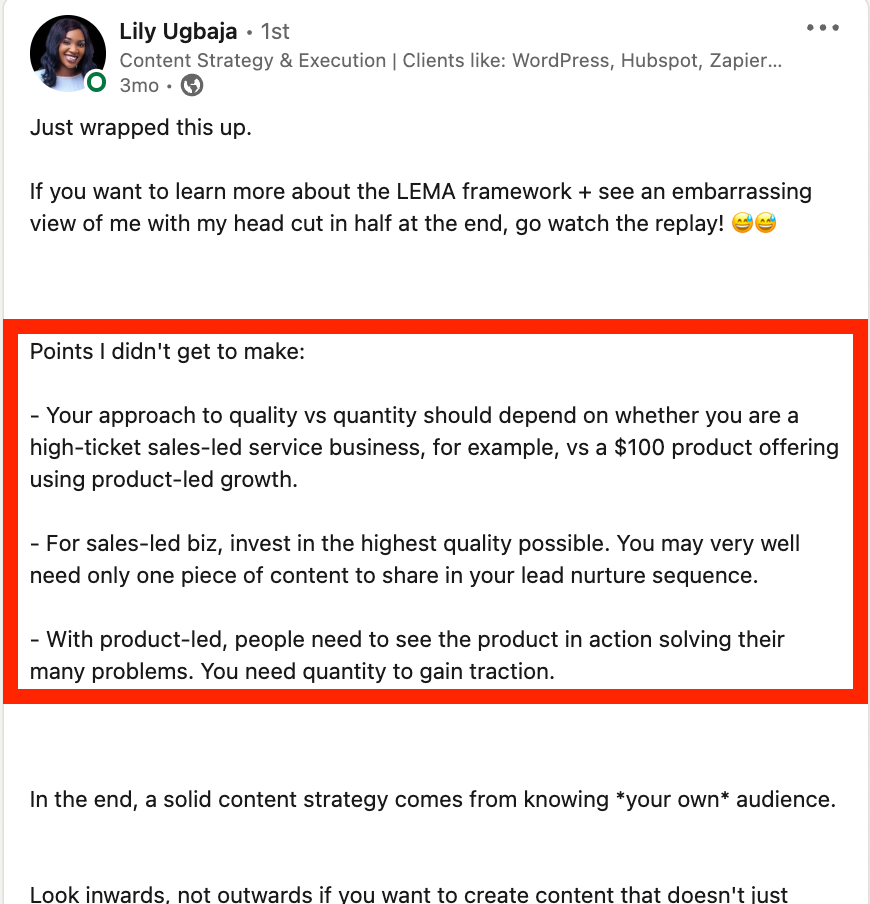
But what is her stance on quality vs quantity now?
“Standing out with quality, even if you are creating just one piece of content, carries way more weight than publishing frequency right now because of how easy it is to just publish content.” - Lily Ugbaja
The blazingly-fast rise of AI software such as ChatGPT changed the content marketing game forever. Writing a fairly run-of-the-mill article now takes a few keyboard bashes.
This is why high-quality content will make any business stand out in a sea of high-volume generic sameness.
“It really doesn’t matter if you are creating for a ton of people or you are creating for a C-level executive, you need quality content right now.” - Lily Ugbaja
One extremely effective way of consistently creating quality content is implementing the LEMA framework.
The LEMA Content Framework
The LEMA framework helps writers create remarkable content.
The stuff that connects to the reader's soul and turns them into paying customers.
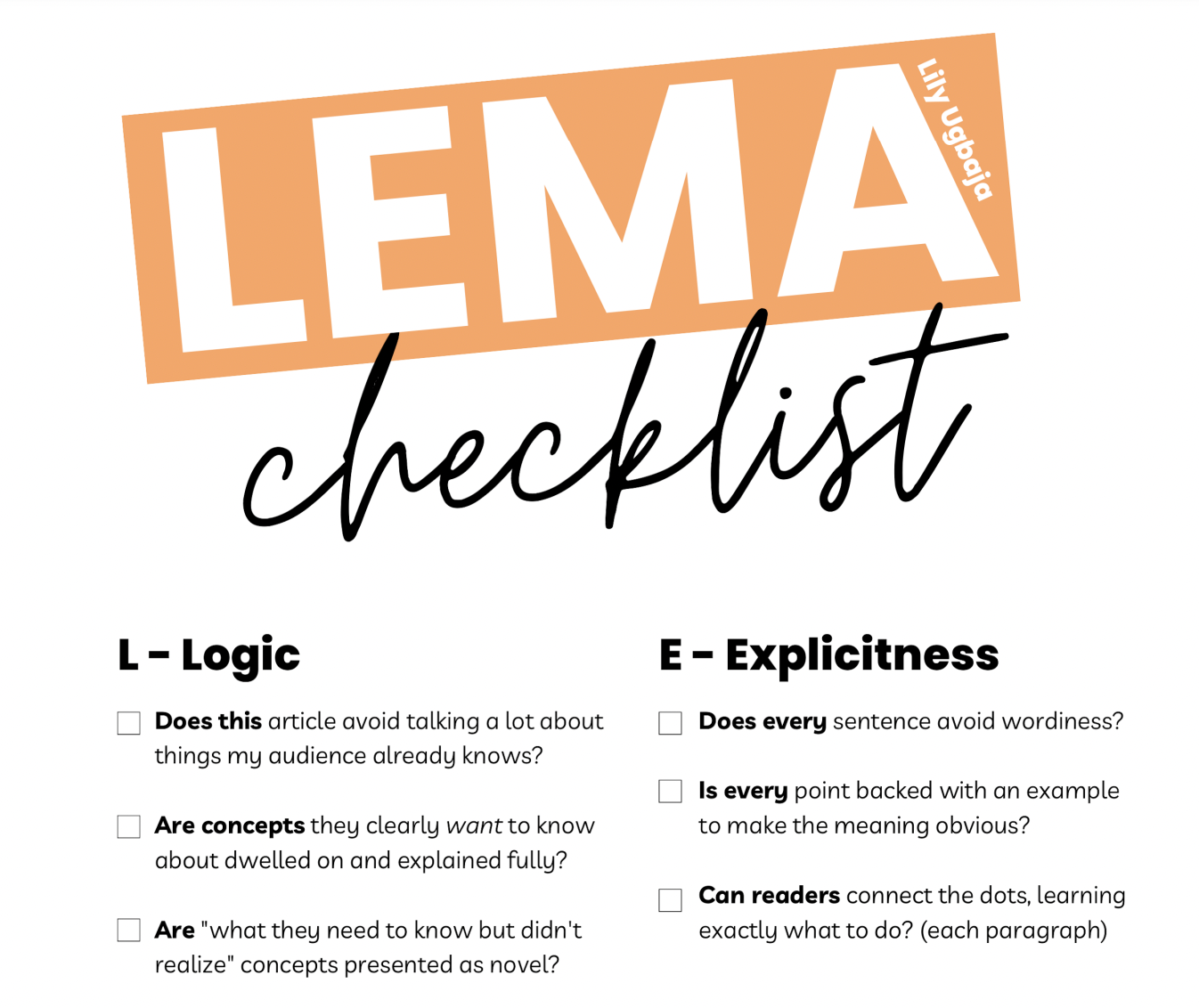
It consists of four pillars of content:
- Logical
- Explicit
- Memorable
- Actionable
“[These four pillars] inspire the reader, make your brand stand out both in the search engine rankings and on social networks. [...] These are the elements that make the reader really connect to what is on the page, [...] remember your brand, share your brand, advocate for your brand, and whenever they see content from your brand come up again, they want to click on you.” - Lily Ugbaja
Lily has developed this incredibly useful content framework while working for marketing giants such as Hubspot, Zapier, Hotjar, and Animalz.
Let's run through LEMA.
L in LEMA: Logic
“Logic is what restricts your scope so that you’re only writing what your audience wants to know, and in the order that they need to know those things.” - Lily Ugbaja
Lily gives an example of an article written on the subject of tomatoes. It may include information such as:
- Whether tomatoes are fruits or vegetables
- What color they are
- The history and origin of the tomato, and more
“If I’m your reader and I’m trying to cook with tomatoes and I want to know their nutritional value, I’m not really interested in the history of the tomato.” - Lily Ugbaja
Here are three ways you can implement logic in your content.
1/ Answer questions about your audience.
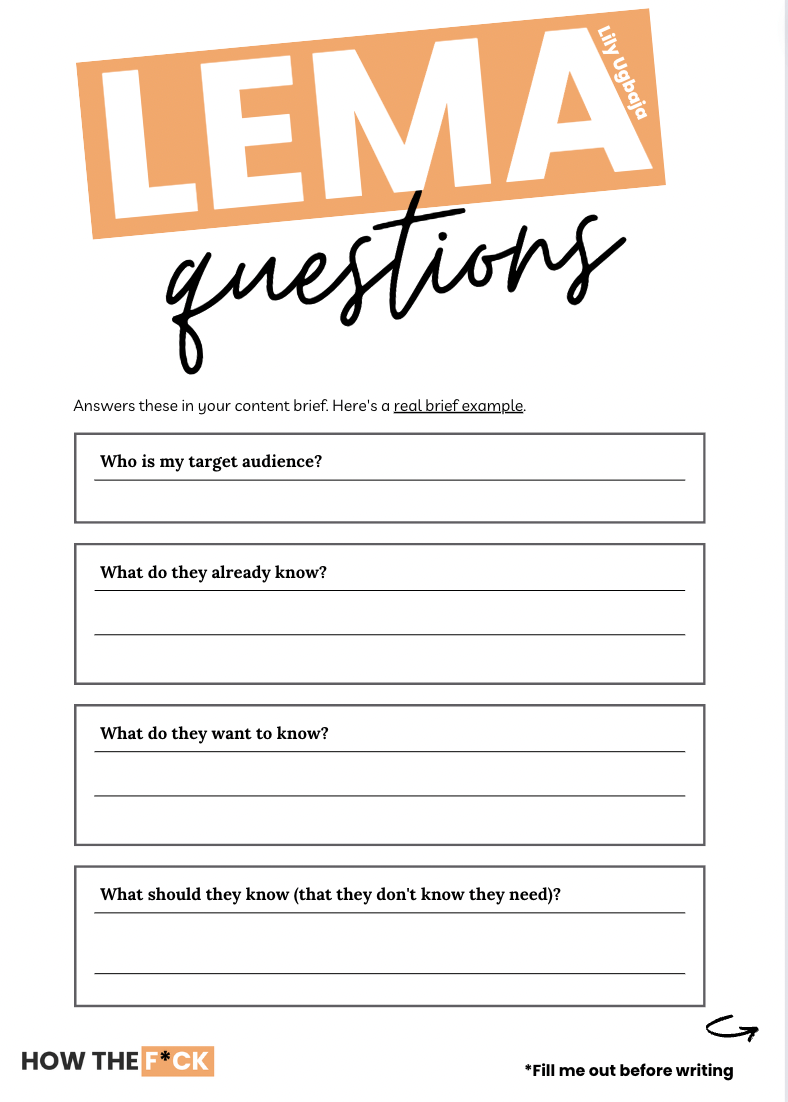
These questions should be crystal clear before starting writing:
- Who is this person that I am writing for?
- What do they already know? - These concepts don’t need explaining in your content.
- What do they want to know? - These concepts should be explained first and in great detail.
- What is it that they should know that they are not thinking about right now? - These concepts can be positioned as novel to the reader.
“Logic is a structure and the formatting of your article that follows your audience’s thinking for the particular place where they’re at right now.” - Lily Ugbaja
But how can you know what your audience already knows?
As Lily says, it’s all in the main keyword you’re targeting.
For example, if you are writing an article for the keyword best CRM tool, consider the person who is searching for this.
They (likely) already know what a CRM tool is - there’s no need to add an entire section titled What is a CRM tool? at the very top of the article.
But all the articles are doing it!
And because all articles are doing it, yours might appear not comprehensive enough to Google to rank high.
This is where Lily offers two options:
- You can still include your "What is a CRM tool?" question, just place it at the very bottom of the article, in an FAQ section. “Any keyword that is important to the general theme of the article but doesn’t really fit the structure of the article can go in the FAQs,” Lily says.
- You don’t have to create an entire section to define the concept of a CRM tool. Simply explain the term naturally in the body of the text.
Either way, you satisfy the search engine, and you don’t disrupt the reader who is just looking for a list of CRM tools they can try out.
2/ Implement MECE.
MECE stands for Mutually Exclusive and Collectively Exhaustive.
- Mutually exclusive means that the information in your article does not repeat or overlap.
- Collectively exhaustive means that there are no obvious gaps in information in your article.

Lily speaks from experience on the importance of MECE:
“So there’s one thing that I find when I edit content from other writers that really, really bugs me. Say, in one paragraph we’re talking about something, and then I come to another paragraph and there’s repetition of that same thing. It’s not that it doesn’t completely fit there, but if we had done a better job, we would be able to separate everything so that each section has its own completely different content.” - Lily Ugbaja
3/ Imagine you are talking to a friend.
Let's go back to our example keyword best CRM tool.
If you asked a friend what they thought were the best CRM tools, how would they respond?
They certainly wouldn’t just list a bunch of CRM tool names at the drop of a hat. They wouldn’t first want to explain to you what a CRM tool is or have a long-winded introduction to their answer.
“‘Oh, the best CRM tools are Hubspot and so and so and so’ - basically what the H2s should be. If you are talking to a friend, you would say Hubspot, and you would say why. And that’s basically what your structure should be.” - Lily Ugbaja
E in LEMA: Explicitness
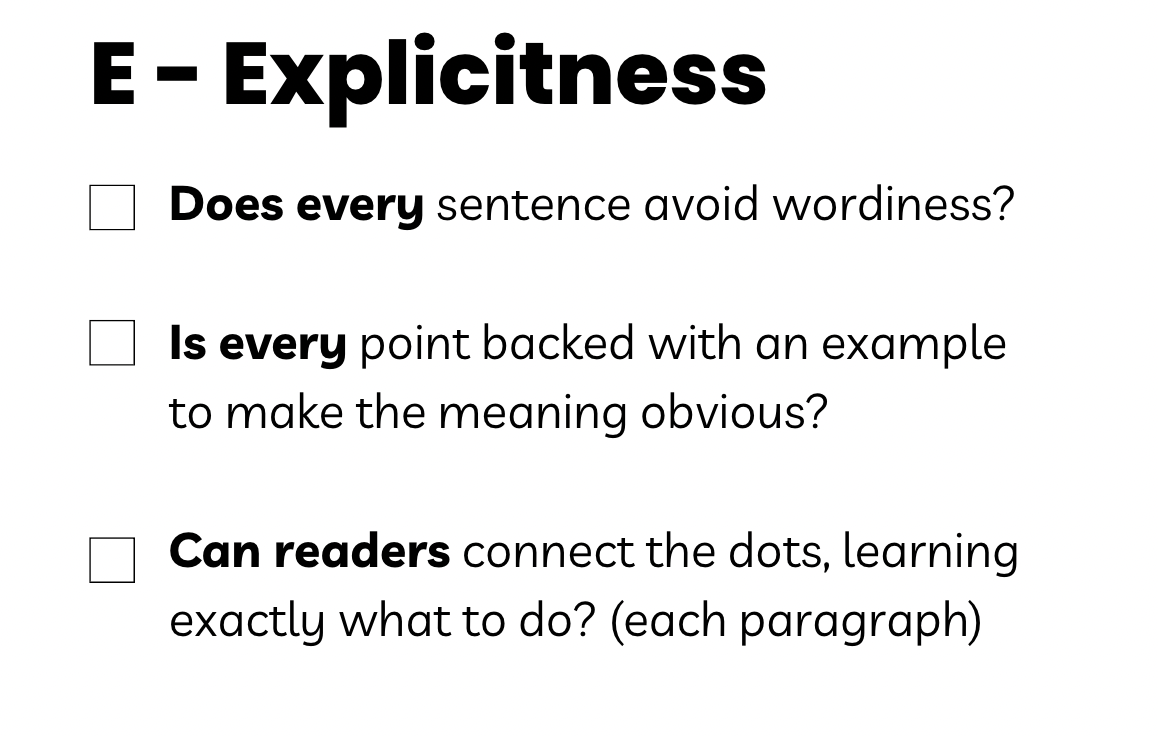
“Explicitness helps you clearly and accurately convey the intended message to the reader. The reader doesn’t have to assign their own meaning to your words.” - Lily Ugbaja
Here’s an example: near the beginning of this article, I wrote this sentence: ‘In short, the LEMA framework helps people create remarkable content.’
But the phrase remarkable content can mean different things to different people:
- Content that the readers want to share.
- Content that the readers will remember.
- Content that will awe and inspire the reader.
- None or all of the above.
So this would be an example of writing not being explicit enough.
The ultimate goal of using explicit writing is to help the reader get through an entire article, to scroll through the text without any friction, and take the action we are hoping for them to take at the end.
How do you pinpoint writing that needs more explicitness?
“When I’m reading through a draft and I find myself stopping to think about something, it means that there is a gap there that I need to fill in with explicit content.” - Lily Ugbaja
Let’s say that a reader who has never heard about analytics tools is reading this sentence: ‘Now you use your analytics tool to check your website’s search traffic.’
They will get confused. What is an analytics tool?
A sentence that is more explicit, with more explanation, would be: ‘Now you use your analytics tool (i. e. Google Analytics) to check your website’s search traffic.’
Reading that second sentence, the reader has a clearer idea of what an analytics tool is. They have an explicit example - no guesswork involved.
Add more explicitness where needed in your content with:
- Examples
- Analogies
- Graphics
- Screenshots (especially when writing step-by-step processes)
- Explaining points
“When I’m reading through an article and there’s no screenshot describing what the action would look like, even when I know what the action would look like, it feels like a disconnect. My brain has to stop and think about what that action would look like instead of seeing it right there on the page.” - Lily Ugbaja
M in LEMA: Memorability
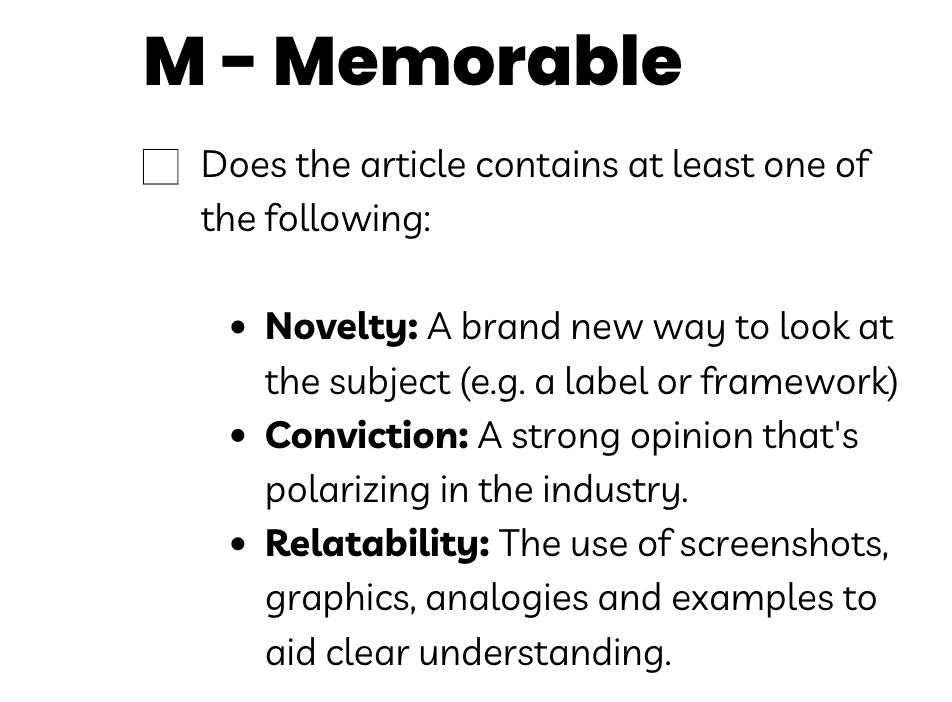
Screenshots also play a big role in the M part of the LEMA framework - memorability.
“When something is clear, as in picture clear, when something paints a picture, you remember it more.” - Lily Ugbaja

How Lily uses screenshots to clarify a point, taken from one of her articles.
Memorable content:
- Is worthy of the reader’s attention
- Captures the reader’s attention
- Keeps the reader’s attention
Here are three ways you can make your content more memorable.
1/ Coin names for (old and new) concepts
Lily describes coined concepts (such as the infamous skyscraper technique in content marketing, or the concept of product-led content) as the pinnacle of great content.
The LEMA framework in itself is a coined concept.
“These are things that were coined to talk about techniques that probably already existed or were [already] invented. The reason why we remember them until today is because they were given a name.” - Lily Ugbaja
Coining a name for an unnamed concept that may already exist (or even coming up with a completely new concept!) adds novelty to content, instantly making it memorable.
2/Be polarizing
Another way of injecting novelty and memorability into your content is by introducing new opinions or new perspectives, especially ones that are polarizing.
Unexpectedly, Lily named my Monday.com SEO case study as a great example of content that is:
- New, fresh, novel - never before seen in quite that package
- Also polarizing
3/ Be relatable
“If you’re writing a piece of content, and throughout the piece of content you’re sprinkling examples of how someone who is in the shoes of your target reader has done something, it becomes so much easier for the person to relate to what you’re writing. Because they can literally see themselves solving the problem in the way that you showed because you’re using an example that is relatable to them.” - Lily Ugbaja
To improve the memorability of her content, Lily relies on similar elements as she does for explicitness:
- Screenshots to show processes.
- Examples to describe what a concept would look like applied to real life, preferably using an example of someone who is already in the shoes of the reader.
- Analogies to introduce the reader to more advanced concepts.
- Custom graphics to map concepts.

A in LEMA: Actionability
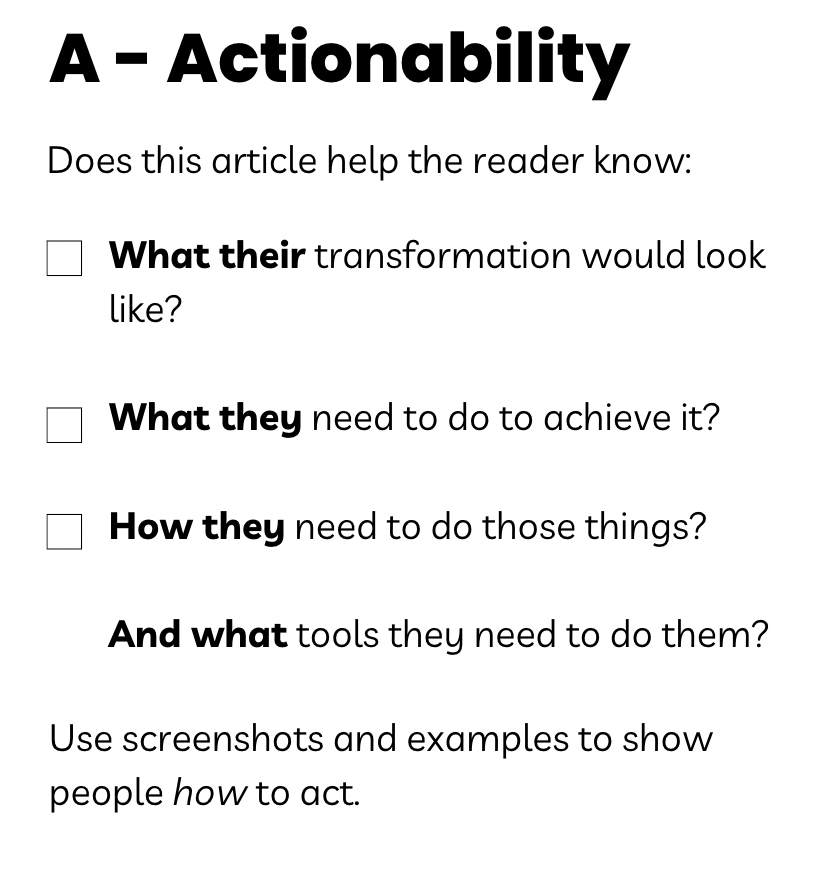
Most people look for specific content because they want to achieve a specific goal (do something).
Truly remarkable content (there I go with that phrase again) helps the reader take action at the end and get the end result they are looking for.
Here are four ways you can get your readers to take action after reading your content:
- Describe exactly what their transformation will look like.
- Describe what they need to do to achieve that transformation.
- Show them how to do these things.
- Provide them with the tools they need to complete the transformation.
For example, with this article, I made you a LEMA framework checklist to help put these concepts into action. That's the A in actionable.
Below I'm gonna show you a real piece of content—that helps you really understand what quality looks like and benchmark yourself.
Final Tip on LEMA Implementation: It’s All in the Outline
Continually writing high-quality content that follows the LEMA framework is challenging.
But with the right systems, it isn’t impossible.
Lily highlights three steps you need to get just right in your processes to be able to scale high-quality content creation:
- The content brief - The brief empowers your writer. It talks about who the audience is, where they are in their journey, and what the goal of the article is.
- The article outline - At this stage, it should be obvious what is missing from the content to make it truly great. It is the final revision of the content structure, adding or removing sections.
- The draft - In this stage, all the gaps are closed and there are elements of memorability in the article.
To give you a better idea of what a good brief and outline look like, Lily provides her actual outline for an article she wrote.
Good luck in creating that show-stopping content!