

Most SEO content is boring as hell. Let's fix that.
Most SEO content is dull as dishwater.
We're pretty savvy in this industry at serving "search intent" (aka creating content that delivers what a searcher is looking for).
The easiest way to make sure you're doing this is to reverse-engineer Google:
- Google your keyword
- See the content type and angle that's ranking in positions 1-3
- Create the same
However, the problem with this is...everyone is doing it (#SEO)
Result:
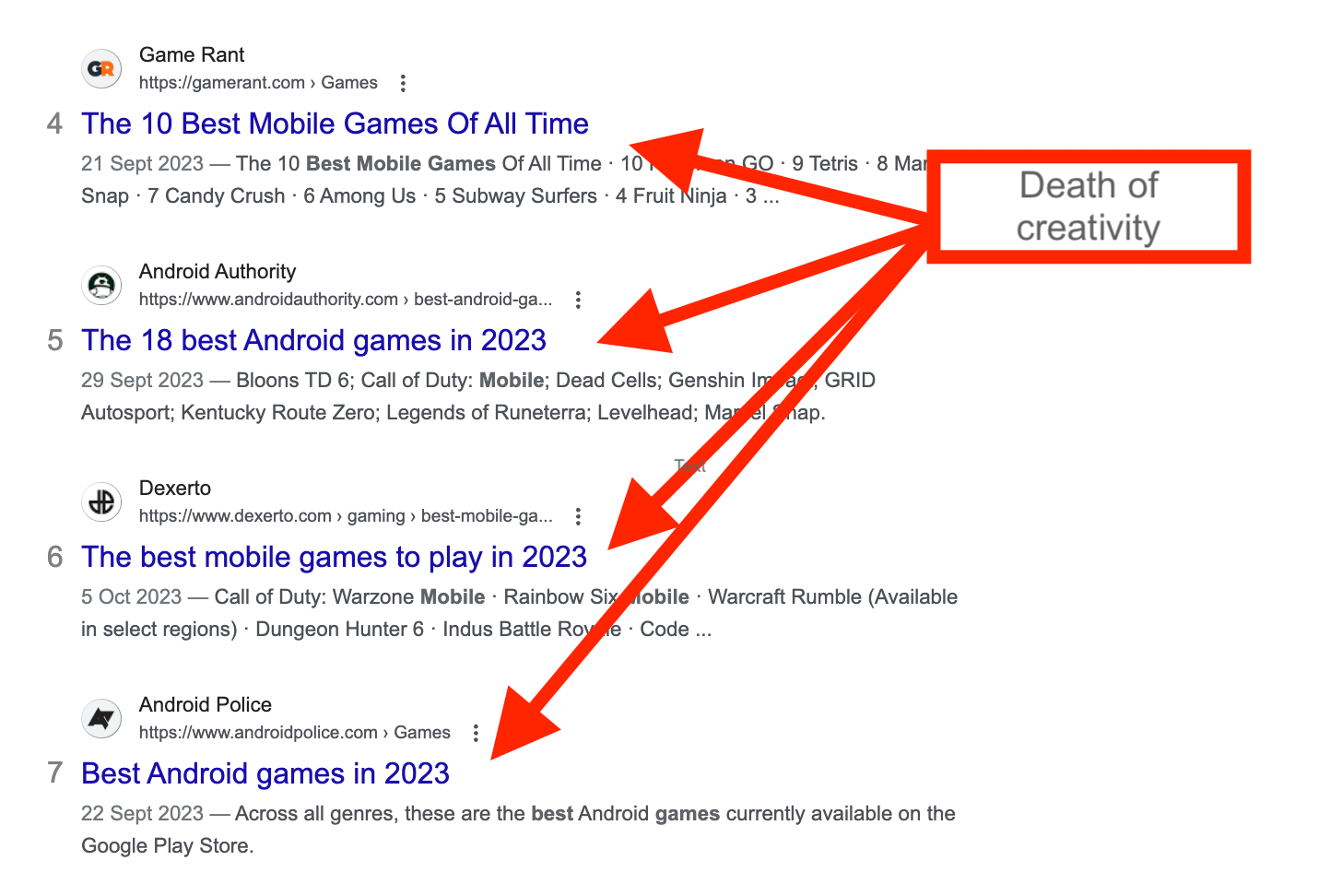
In marketing, when something becomes best practice...it stops being best practice.
Because great marketing is memorable.
It helps you stand out.
It differentiates you...so your company glows, fiercely in people's minds.
I'm not telling you to make your titles more interesting.
This is deeper than that.
The last thing you want is for someone to click your article...and then realize you lied in the title.
We all hate clickbait.
We want to click your article because it sounded unique and interesting.
We then want it to deliver a resounding, mind-changing argument that makes us smarter and closer to our goal. 🙏
Most SEO content these days is so damn surface level it hurts.
It all reads like a "101" course on the subject (if ChatGPT can write it, I don't want to write it).
Where are the quotes from cutting-edge thought leaders?
Where are the diverse perspectives?
The interesting takes?
The fun themes?
Let's fix that.
Crafting a Better Thesis (So You Rank AND Stand Out)
From here on out, I want you to have a clear thesis before creating any content.
A clear thesis:
- Gives direction for the writer: all elements of a piece align with a central message or direction.
- Gives coherency for the reader: every piece of information should support the thesis. It frames what you're writing and why.
It also makes your content the obvious choice in the sea of sameness.
Let's look at some quick examples.
Example - Best Drones
Let's say you're writing an article targeting the keyword "best drones".
You look at the SERPs and find 8 listicles titled "The 7 Best Drones in 2023".
Bleh. Boring. It's been done before.
Here are 5 angles (and theses) you could take instead:
- Angle: "The 7 Best Drones - Quiet & Eco-Friendly"
- Thesis: "In the era of environmental consciousness, drones that prioritize quiet operation and eco-friendly features not only reduce noise pollution but also minimize their ecological footprint, without compromising on speed and agility."
- Angle: "The 7 Best Drones - Under £100"
- Thesis: "Affordability doesn't mean compromising on quality or functionality; the best drones under £100 offer a harmonious blend of performance, features, and value for money."
- Angle: "The 7 Best Drones - For Cinematography"
- Thesis: "Capturing breathtaking cinematic shots requires drones equipped with superior camera technology, stability, and flight features; these seven drones stand out as the best in transforming cinematographic visions into reality."
Each of these angles (and their subsequent thesis) would tie the piece together nicely and provide a unique perspective throughout.
Example - How to Grow...
This also plays out across pain point content.
For example, let's say I'm a software provider for Pilates Studios.
The company:
- They want to be known for being modern and innovative.
- They want to target studio owners who are ambitious and growing.
We find the long-tail keyword "How to grow a Pilates studio brand".
To make sure we breathe our brand into our search content and connect with the right readers, we should consider these theses:
- Angle: "How to Grow a Pilates Studio - Cutting-Edge Tactics for Aggressive Growth"
- Thesis: "To achieve aggressive growth in today's competitive fitness landscape, Pilates studios must seamlessly integrate traditional growth strategies with cutting-edge software solutions that optimize operations, enhance customer experiences, and drive unparalleled business scalability."
- Angle: "How to Grow a Pilates Studio: Scaling Beyond Local Boundaries with Software Solutions"
- Thesis: "Transitioning from a local favorite to a recognized industry leader requires Pilates studios to integrate cutting-edge software tools that enable efficient scalability, strategic marketing, and enhanced client engagement."
See how this gives direction, coherency, and a certain je ne sais quoi to each article?
Side note: I'd recommend not making every one of your articles an attempt to argue why your software is the best solution. That's boring as f*ck whichever way you do it.
Instead, I recommend finding a thesis that's:
- Novel
- Based on your experience
- Taps empathetically into the reader's challenges
When every other article is a generic listicle, this is your opportunity to take a new perspective, tell your story, and make your case for the best way to solve this problem.
Make your thesis align with your brand values or product mission—that way you further develop your brand and product awareness in people's minds.
Sprinkle this into your next article. Let me know how it goes.
—Benny
P.S. It's really easy to ideate angles and theses in ChatGPT. Just tell it your keyword and ask it to come up with 10 angles and thesis ideas.
P.P.S. You should still play Google's mind games and create an outline similar to those in the SERPs right now. But make sure it all ties back to your thesis and your content zings.
Build a Beast-Mode Content Operation
1. The Scalable SEO Operation Package: Join 100s of SEOs & Content Leaders inside the Scale Package. This is a comprehensive guide, ops dashboard, and template library for building a scalable content operation that drives real revenue results. I've personally used this system to scale my latest client to 70,000 clicks/month in 5 months—in as little as 2 hours per week of management.
Use code: FRIENDS10 to get a 10% discount.
2. Become a How the F*ck Premium member: Join 253+ monthly members who enjoy access to 30+ of the most incredible SEO case studies (and regular new ones). We've heard the inside secrets behind successful growth stories like Hotjar, Typeform, and Monday, as well as incredible niche sites like Living Cozy and Retro Dodo. These stories are how you build a real search-first growth engine.